Mega-ASR: group-relative RL needs a reward that ranks failed transcripts
Mega-ASR makes Qwen3-ASR robust to degraded, in-the-wild audio with group-relative RL, and why it needs a reward that can rank failed transcripts.
Mega-ASR is a robustness recipe for Qwen3-ASR-1.7B that cuts its average WER on three robustness benchmarks from 7.93 to 6.70.
The four parts, and the ASR-in-the-wild² target
Mega-ASR is a robustness recipe for Qwen3-ASR-1.7B, an audio-LLM ASR system in which an acoustic encoder feeds an aligner (an adapter that maps encoder outputs into the LLM's embedding space) and the LLM decodes the transcript. On the three standard robustness benchmarks, the recipe cuts the backbone's average WER from 7.93 to 6.70.
The recipe has four parts: Voices-in-the-Wild-2M, a 2.4M-clip simulated corpus of compound acoustic degradation; Acoustic-to-Semantic progressive supervised fine-tuning (A2S-SFT), a three-phase LoRA schedule; an RL stage, Dual-Granularity WER-Gated Policy Optimization (DG-WGPO), built on the group-relative method DAPO; and an inference-time router that activates the robust weights only when the input is degraded. The target is what the authors call ASR-in-the-wild²: speech that is both in the wild and degraded by several effects at once, where word error rate (WER: substitutions, insertions, and deletions divided by reference word count) rises past 30%.
The finding with the widest scope is in the RL stage: running DAPO with the standard 1 - WER reward moved little over the supervised checkpoint. The rest of the pipeline encodes the same idea at the data level.
The gains appeared after the reward was rebuilt to score how a transcript fails, not how many words it gets wrong.
Mega-ASR: a four-part robustness recipe for Qwen3-ASR-1.7B
- Simulated data
- A2S-SFT
- DG-WGPO
- Router
What each step involves
The recipe's parts, in the order this post covers them
- Simulated data
- Voices-in-the-Wild-2M: 2.4M clips of compound acoustic degradation
- A2S-SFT
- A three-phase LoRA schedule grounds the encoder and aligner first
- DG-WGPO
- Group-relative RL on DAPO, with a reward that ranks how a transcript fails
- Router
- Activates the robust weights only when the input is degraded
Severe degradation changes the failure mode, not just the error rate
The paper's organizing observation is a regime boundary, and beyond it the model has lost acoustic grounding: the language model fills the gap with whatever its prior finds likely.
Two regimes, split at roughly 30% WER
At or below ~30% WER: word-level confusions
Acoustically plausible substitutions a reward can grade locally.
Beyond ~30% WER: sentence-level breakdowns
Fluent hallucinations, large omissions, and empty outputs.

Under severe degradation, the baselines fail by omission and fabrication, not word confusion. Source: Mega-ASR paper, Figure 6, p. 10.What to see
the far-field panel shows the failure-mode shift. Neither baseline failure is a word confusion.
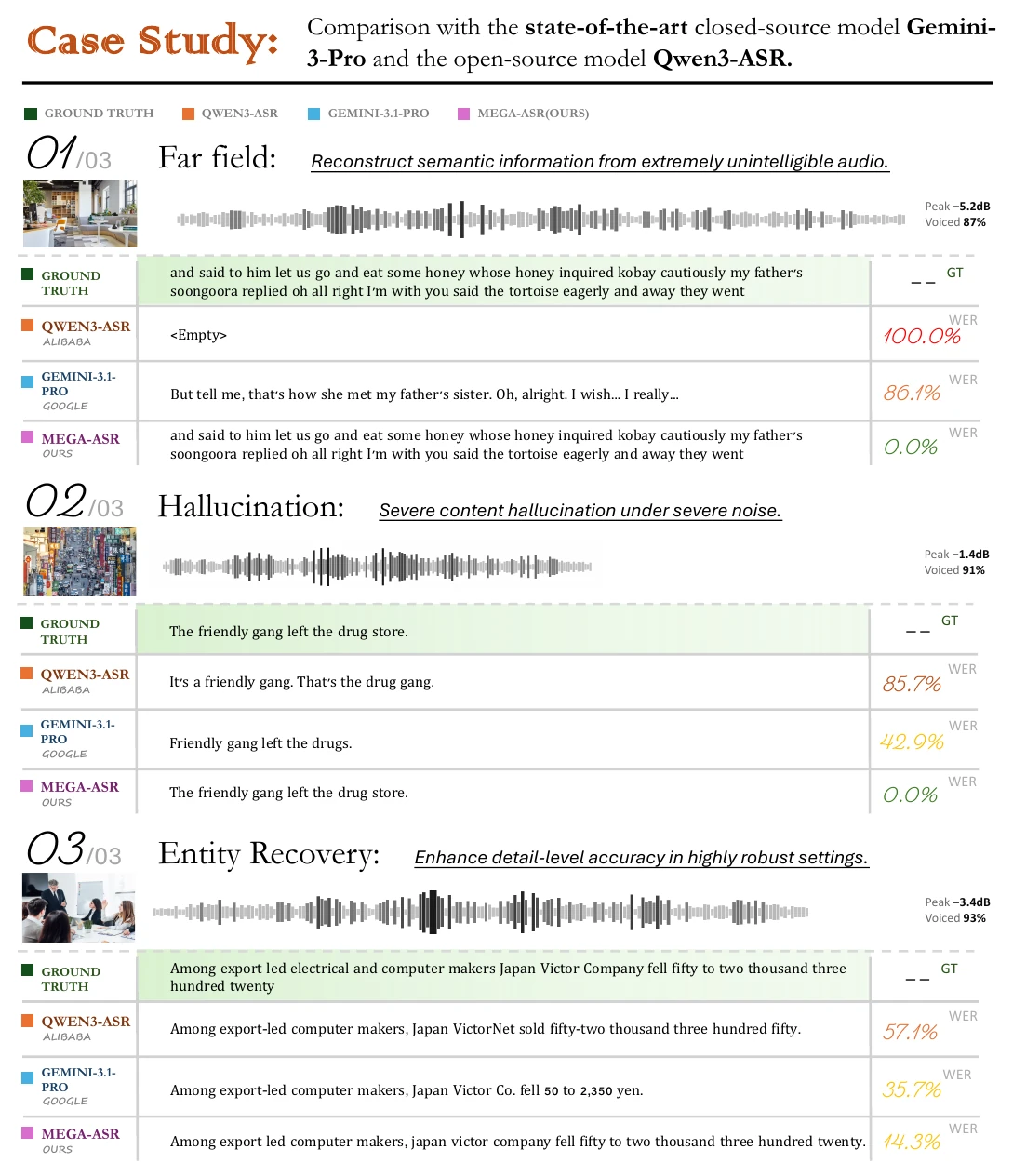
On the same heavily degraded clip, Qwen3-ASR returns nothing and Gemini-3.1-Pro fabricates, while Mega-ASR recovers the reference exactly.
Where the boundary shows up in the pipeline
- Datasetdiscards generated samples above the 70% WER cap
- SFT phase oneorders its curriculum by the same thresholds
- RL splitenriched in medium- and high-WER examples
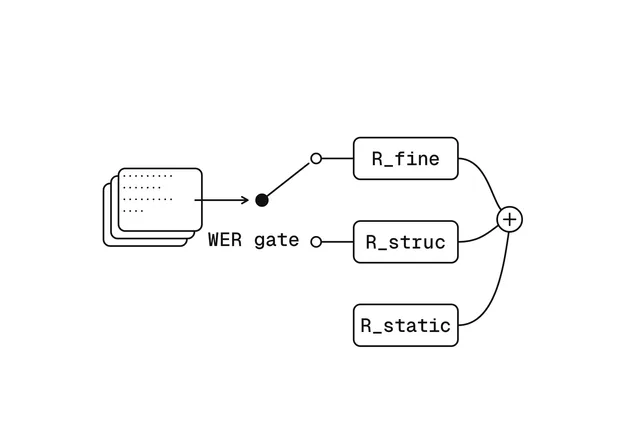
- RL rewardswitches its emphasis at a WER gate
The far-field case as a table, how firm the 30% boundary is, and why the 70% cap
| System | Far-field case-study output (Figure 6) | WER |
|---|---|---|
| Qwen3-ASR | an empty transcript | 100% |
| Gemini-3.1-Pro | fluent content unrelated to the audio | 86.1% |
| Mega-ASR | the reference, recovered exactly | exact match |
The evidence for the boundary is observational (training-time inspection and case studies), and the same 30/50/70 numbers reappear as the pipeline's hyperparameters, so read the specific threshold as the paper's chosen operating point rather than a measured phase transition.
Every pipeline stage is built around this boundary. The authors observed that samples above the 70% cap destabilize training, and the RL split is selected by each example's stored base-model WER.
Voices-in-the-Wild-2M: seven effects, 54 scenarios, one severity value
Released robust-ASR corpora mostly cover one or two isolated conditions the backbone already handles at 4-10% WER; this one composes effects.
Voices-in-the-Wild-2M
- 54compound scenarios
- 7atomic effects
- 8primitive signal operators
- 2.4Mclips, 11K hours

Seven atomic-effect tiles expand into 54 hybrid scenarios. Source: Mega-ASR paper, Figure 2, p. 4.What to see
the seven atomic-effect tiles expand into the 54 hybrid scenarios; the header panel carries the corpus scale (2.4M clips, 11K hours).
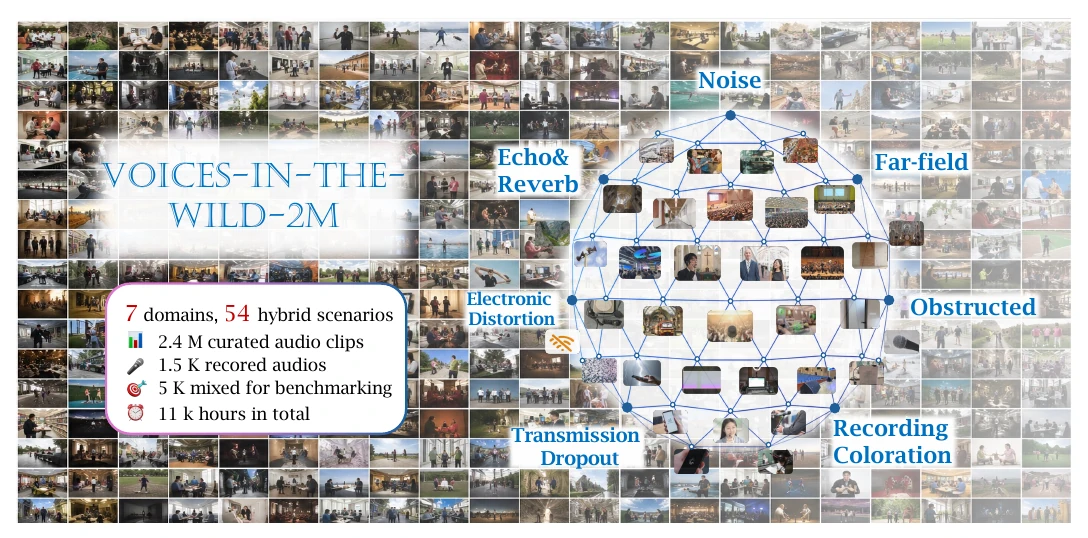
The seven atomic effects, under the anchor-modifier rule
Geometries (anchors)
Mutually exclusive propagation geometries that never combine with each other:
- Far-field
- Echo&reverb
- Obstructed
Modifiers
Attach to any geometry:
- Noise
- Recording coloration
- Electronic distortion
- Transmission dropout
One severity value per sample sets every active operator, so a hard sample is hard everywhere.
Why compositional difficulty, operators and effect chains, source corpora, and severity sampling
Stacking degradations is standard augmentation practice; what the released robust-ASR corpora the paper compares against lack is compositional difficulty, since they mostly cover one or two isolated conditions that the backbone already transcribes at 4-10% WER. The corpus is built as a three-level compositional hierarchy: eight primitive signal operators compose into seven atomic effects, and the atomic effects compose into 54 compound scenarios.
The eight primitive signal operators are additive noise, echo delay, reverberation, nonlinear distortion, resampling, spectral filtering, loudness transformation, and frame-level stutter. Each atomic effect is an ordered operator chain with one dominant operator plus the secondary artifacts that physically co-occur with it: far-field is reverb, then low-pass filtering, then a loudness drop, because a distant speaker is simultaneously more reverberant, spectrally attenuated, and quieter; obstructed (speech through a wall, door, or mask) is dominated by repeated low-pass filtering. The clean speech underneath comes from public English and Mandarin corpora (LibriSpeech and Common Voice; WenetSpeech and AISHELL-1), with noise drawn from MUSAN and similar collections.
The enumeration is rule-based but not exhaustive: at the three-effect level only 9 of the 18 possible anchor-plus-two-modifier combinations are kept, and the introduction credits an "agentic check" for physical plausibility that the paper never specifies.
Each sample draws a single severity value shared by every active operator; every operator parameter declares which direction is harder and is set from that one value. Independent per-effect sampling would produce incoherent samples (severe reverberation over an otherwise pristine recording); the shared value makes a hard sample hard everywhere.
Linear severity sampling beat hard-biased, easy-biased, and middle-biased alternatives in the paper's 50K-sample pilot runs. The per-effect parameters were tuned against real recordings via SFT validation, though the paper names neither the calibration set nor the fit objective, and its own difficulty numbers conflict: the comparison table puts the backbone at 18.42 average WER on the corpus, the text says 35%. Either figure is well above the corpora it compares against.
A2S-SFT: ground the encoder and aligner before the language prior adapts
Heavy degradation needs reliable acoustic evidence first, then the language prior to fill gaps; the stages train them in that order (rank-8 LoRA).
A2S-SFT, three phases
- Phase one: encoder and aligneronly they update, on a WER-threshold curriculum
- Phase two: LLMacoustic side frozen, full targeted split, no curriculum
- Phase three: everythingjoint update, acoustic side on a lower learning rate
Unstaged SFT on the same data recovers only about half of the staged schedule's improvement (ablation below).
The two bottlenecks the stages target, and why the order matters
Recognition under heavy degradation has two coupled bottlenecks: extracting reliable acoustic evidence from a corrupted signal, and using the language model's prior to reconstruct the transcript when that evidence is only partially reliable. The supervised stage trains them in that order, with rank-8 LoRA throughout.
The schedule itself is the standard align-then-joint recipe for multimodal LLMs; the additions are the phase-one curriculum and a measurement of how much the staging is worth. In the ablation table below, unstaged SFT on the same data recovers only about half of the staged schedule's improvement.
Phase one's curriculum expands through the three WER thresholds in order; phase two adapts the LLM on the full targeted split, activating semantic recovery; phase three's lower acoustic learning rate preserves phase one.
The order matters for the same reason the high-WER failures look the way they do. In the authors' preliminary variants, joint training from the start was unstable on medium- and high-WER samples because the LLM adapted to acoustic representations that were still unreliable, and adapting the LLM before the acoustic warm start made the model more prone to relying on its language prior. A prior that learns to override a noisy encoder during training is the same mechanism that produces fluent off-audio transcripts at inference.
DG-WGPO: a reward that keeps ranking after the WER reward saturates
The RL stage learns only from reward differences within each group of transcript candidates (GRPO/DAPO post).

Under heavy degradation the plain WER reward saturates, so the group stops producing gradient exactly where the policy needs it.
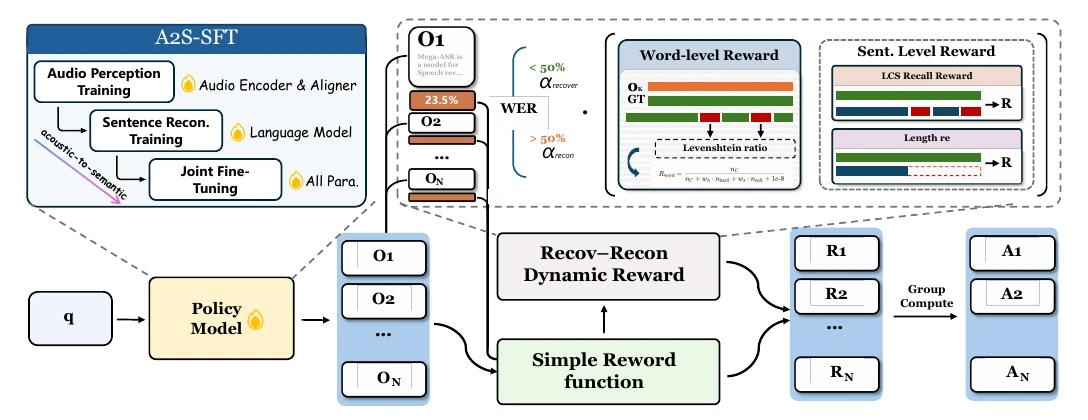
A WER gate mixes a token-level and a sentence-level reward, on top of a static WER anchor. Source: Mega-ASR paper, Figure 4, p. 5.What to see
left, the three A2S-SFT phases. Center: the policy's rollout group, scored by a static rule-based reward and by the dual-granularity dynamic reward whose two terms a WER gate mixes. Right: the combined rewards become group-relative advantages.
The three reward terms, why insertions count fully, MWER lineage, and the paper's conflicting settings
The three reward terms
R_static: the anchor
R_rep * (1 - WER), where the repetition gate R_rep zeroes any rollout that collapses into repeated n-grams.
R_fine: token level
A near-miss substitution (character-level edit similarity at or above 0.5) is discounted to 0.4 of an error; insertions and deletions always count fully.
R_struc: sentence level
Ignores token identity: half longest-common-subsequence recall, half a length-integrity term that reaches zero when the hypothesis is empty or runs away.
The RL stage samples a group of transcript candidates per audio clip and updates with GRPO-style group-relative advantages under the DAPO loss: each candidate's advantage is its reward measured against the group's, so the learning signal lives entirely in within-group reward differences. Our GRPO/DAPO post covers the general mechanism and DAPO's changes to GRPO.
A reward that stops discriminating between candidates therefore stops producing gradient, and the paper reports exactly that failure for the plain WER reward: under heavy degradation it saturates, collapsing reward dispersion within the rollout group precisely where the policy most needs signal.
R_struc is what separates an empty output from a truncated-but-faithful one from a fluent fabrication, distinctions that all live in the saturated tail of 1 - WER. A WER gate, evaluated on each rollout's own WER against the reference, swaps the two dynamic weights at a threshold: below it the token-level term dominates the mix, above it the sentence-level term does, and the final reward weights the dynamic pair over the static anchor.
Sequence-discriminative training against expected word error (MWER, sMBR) is decades-old ASR practice and works in its regime; what breaks here is the group-relative estimator.
The redesigned reward keeps R_static as an anchor; on top of it sits a dynamic reward with two terms. R_fine splits substitutions by character-level edit similarity, while insertions and deletions always count fully, since unlike a near-miss substitution neither is an acoustic confusion. R_struc scores structural preservation of the reference.
The gate threshold is 0.3 in the main text and its sweep but 0.5 in the appendix and in the framework figure above, and the two halves of the paper also disagree on the RL learning rate, the rollout count (16 versus 12), and the SFT learning-rate scheme, so the released numbers pin down the design but not the exact operating point.
The ablation: reward design, not the optimizer, carried the RL stage
The table below is measured on the medium- and high-difficulty subsets of VOiCES (a far-field room-microphone corpus) and NOIZEUS (noisy speech at controlled signal-to-noise ratios).
Table 5 in full, and why a tenth of a point is direction, not magnitude
| Variant | VOiCES WER | NOIZEUS WER |
|---|---|---|
| Qwen3-ASR baseline | 8.94 | 9.45 |
| SFT without staging | 8.31 | 8.79 |
| Mega-ASR-Base (staged A2S-SFT) | 7.59 | 8.12 |
+ vanilla GRPO, 1 - WER only |
7.73 | 8.11 |
+ vanilla DAPO, 1 - WER only |
7.62 | 7.98 |
+ DG-WGPO, no R_rep |
7.46 | 7.73 |
+ DG-WGPO, no R_fine |
7.45 | 7.71 |
+ DG-WGPO, no R_struc |
7.54 | 7.85 |
| + DG-WGPO, no gated fusion | 7.41 | 7.68 |
| Mega-ASR (full DG-WGPO) | 7.35 | 7.64 |
Mega-ASR paper, Table 5, page 8. WER (%), lower is better; single runs, no variance reported.
The table covers the VOiCES and NOIZEUS medium- and high-difficulty splits. Single runs, no variance reported; elsewhere the paper lists the full system at 7.53 on VOiCES for what is nominally this same configuration, so treat differences of a tenth of a point as direction, not magnitude.
What the rows say
- ≈4/5of the gain from the supervised rows (corpus and staging, about equally)
- ≈0 on VOiCESWER-only DAPO over the SFT checkpoint
- R_structhe reward term whose removal costs the most
The three readings in full, the gate's small contribution, and the model-judge comparison
- The supervised rows dominate: the corpus alone (unstaged SFT) and the staging contribute roughly equally, and together they account for around four fifths of the total improvement.
- WER-only RL contributed little: vanilla GRPO lands slightly worse than no RL on VOiCES, and vanilla DAPO leaves VOiCES essentially unchanged while capturing about a quarter of the eventual NOIZEUS gain.
- Among the reward components, removing the sentence-level term costs the most, consistent with the regime boundary.
The gating mechanism contributes little: removing the gated fusion costs almost nothing, and the gate-threshold sweep (reported on NOIZEUS only) is nearly flat end to end.
The reward also did not need a model in the loop. Replacing the dynamic reward with a Gemini-2.5-flash-lite judge score changed WER by about 0.1 in both directions across the test sets while roughly tripling the time per RL step. Where the task has a reference transcript, a verifiable rule-based reward already captures what the judge provides.
Every variant of the redesigned reward moves both benchmarks where WER-only RL moved only one, and the optimizer choice (DAPO over GRPO) is worth less than the reward redesign.
The router: cheap degradation detection gates the robust LoRA delta
Always-on robust weights cost accuracy on clean input.
| Benchmark | Qwen3-ASR | Mega-ASR | Mega-ASR routed |
|---|---|---|---|
| LibriSpeech c/o | 1.62 / 3.40 | 1.78 / 3.57 | 1.63 / 3.37 |
| FLEURS zh/en | 3.93 / 3.19 | 5.43 / 3.76 | 3.86 / 3.17 |
Mega-ASR paper, Table 3, page 7. WER (%), lower is better.
The fix exploits an asymmetry: degradation is cheap to detect, so the robust weights apply as a LoRA delta. Classifying audio as degraded is far easier than transcribing it.
The router
- >99.5%clean/degraded accuracy, one Transformer layer over log-Mel features
- -0.8%end-to-end runtime change on CHiME-4, within noise
- 7.52 vs 7.90NOIZEUS full average, always-on vs routed
LibriSpeech and FLEURS, and the router's scope limit: it may be detecting the simulator
LibriSpeech is read clean English speech, scored on test-clean and test-other (c/o); FLEURS is a multilingual read-speech benchmark, scored here in Chinese and English.
A single-layer Transformer over log-Mel features (a standard spectrogram-style featurization) reaches over 99.5% clean/degraded accuracy. Routing then swaps weights by adding or subtracting precomputed LoRA delta tensors instead of reloading the model, and measured end-to-end runtime on CHiME-4 (a noisy-speech benchmark) changes by -0.8%, within noise. The routed system restores the clean numbers above while keeping most of the robustness.
The asymmetry claim comes with a scope limit: the classifier's accuracy is measured against its own training mixture, clean corpora versus the simulator's output, so it may be detecting the simulator's artifacts rather than degradation in general. The behavioral evidence points the same way. On the NOIZEUS full-benchmark average (a different split from the ablation table), always-on weights stay better than routed, 7.52 against 7.90, and on babble noise (overlapping crowd chatter) at 0 dB the routed system is worse than even the unrouted backbone, a pattern consistent with the router misrouting real degraded audio it never saw in training.
Results: gains concentrate where the baseline collapses
Table 2 rows as a table
| Model | CHiME-4 + VOiCES + NOIZEUS average WER |
|---|---|
| Mega-ASR | 6.70 |
| Mega-ASR routed | 6.76 |
| Qwen3-ASR-1.7B | 7.93 |
| Step-Audio-2-mini | 9.50 |
| Whisper-Large-v3 | 10.72 |
| Kimi-Audio-7B | 10.74 |
| Gemini-3-Flash | 15.59 |
Mega-ASR paper, Table 2, page 7. Average WER (%) across the three robustness benchmarks; selected rows of the paper's 13-system table.
Qwen3-ASR already led this comparison, so Mega-ASR extends the field's best baseline rather than rescuing a weak one. The average understates how localized the improvement is.
Where the gains land
- 54.01 → 45.69WER, room-4 far-microphone babble (VOiCES' worst subset)
- 3.30 → 2.73Voices-in-the-Wild-Bench mixed degradation, real
- 5.39 → 4.57the same split, simulated
| Benchmark subset | Where the gain lands |
|---|---|
| VOiCES, far microphone, two hardest rooms | almost all of the gain |
| NOIZEUS, easiest conditions | mostly relative improvement |
| CHiME-4, a few moderate subsets | small regressions |
That is what training against the high-WER regime predicts: large recoveries where the baseline loses grounding, small movement where it never did.
The per-condition gains in words, benchmark overlap with training data, and the LLM-judge evaluation
On VOiCES, the far-microphone conditions in the two hardest rooms carry almost all of the gain. Close-microphone subsets change little in absolute terms, the easiest NOIZEUS conditions improve mostly in relative terms, and a few moderate CHiME-4 subsets regress. That distribution is what training against the high-WER regime predicts: large recoveries where the baseline loses grounding, small movement where it never did.
On the paper's own Voices-in-the-Wild-Bench, Kimi-Audio, the closest external system on the mixed-degradation split, is about a point and a half behind on both columns. What remains open is transfer: every result is on Qwen3-ASR-1.7B, and the recipe's value on a backbone with a different acoustic encoder or a stronger language prior is untested.
70% of Voices-in-the-Wild-Bench comes from the same simulator as the training data, so the simulated columns partly measure distribution fit. An LLM-as-judge evaluation supports the failure-mode story more directly, with the judged hallucination rate falling by about a third and missed content by more than half against the backbone, though the judge protocol is under-specified, so treat those as directional.
Every result is on Qwen3-ASR-1.7B; transfer to other backbones is untested.
Sources
- Mega-ASR: Towards In-the-wild² Speech Recognition via Scaling up Real-world Acoustic Simulation (arXiv 2605.19833)
- Voices-in-the-Wild-2M dataset (Hugging Face)
- Voices-in-the-Wild-Bench (GitHub)
- Qwen3-ASR technical report (arXiv 2601.21337)
- DAPO: An Open-Source LLM Reinforcement Learning System at Scale (arXiv 2503.14476)
What each source supports
- Mega-ASR: Towards In-the-wild² Speech Recognition via Scaling up Real-world Acoustic Simulation (arXiv 2605.19833): all claims and numbers; the regime boundary and reward design (Sec. 4.2), A2S-SFT staging and preliminary variants (Sec. 4.1, Appendix E.1, Table 24), dataset construction (Sec. 3, Appendix C, Table 17), router (Sec. 4.3, Appendix D), ablation (Table 5), reward-versus-judge comparison (Table 6), clean-cost and robustness tables (Tables 2-3, 13), LLM-judge metrics (Table 7), and Figures 2, 4, 6 reproduced above.
- Voices-in-the-Wild-2M dataset (Hugging Face): the released training corpus described in the dataset section (the card lists about 646K examples, a subset of the paper's 2.4M clips).
- Voices-in-the-Wild-Bench (GitHub): the released evaluation benchmark cited in the results section.
- Qwen3-ASR technical report (arXiv 2601.21337): the backbone model fine-tuned throughout.
- DAPO: An Open-Source LLM Reinforcement Learning System at Scale (arXiv 2503.14476): the policy-optimization loss used by DG-WGPO.