TTS models: a map of the modern speech stack by sampled representation
A map of modern text-to-speech systems by the representation their generators sample: codec tokens, mel frames, semantic-acoustic cascades, continuous latents, and hybrid frames.
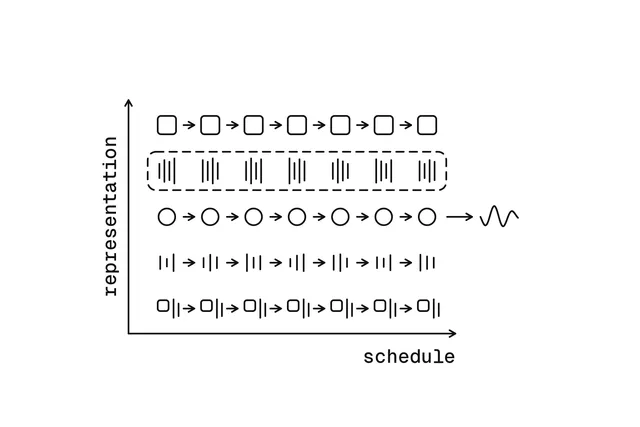
Modern text-to-speech systems are easiest to place by the representation their generator samples, and on what schedule, not by what the paper calls the model.
The sampled representation constrains the generator
Two axes place a system: the representation its generator samples, and the schedule it samples on.

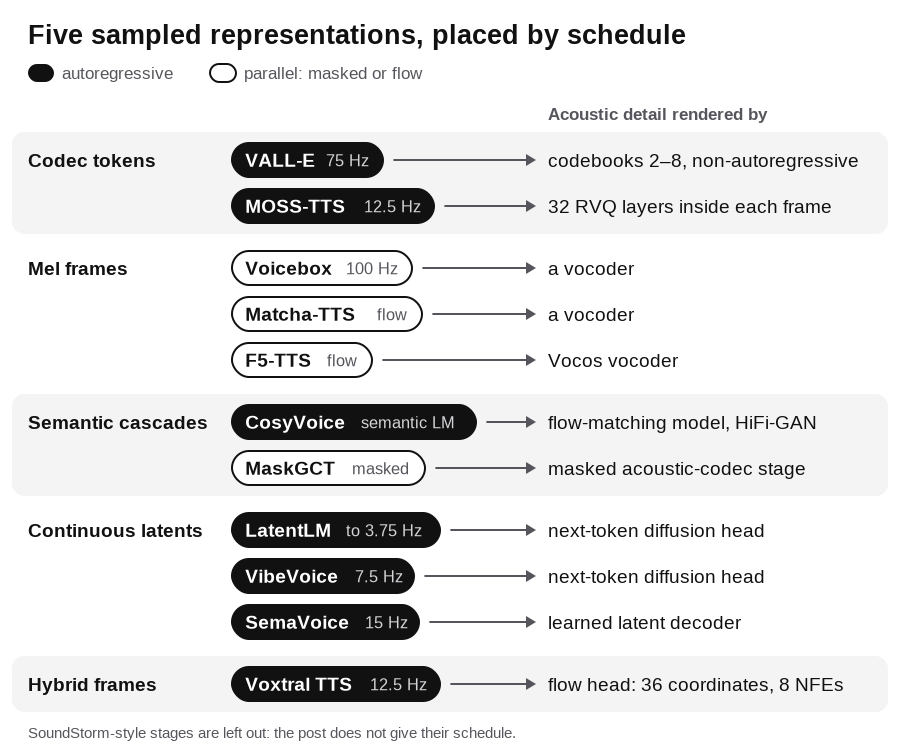
What each prediction target demands, how to read the two axes, and each representation's design constraint
A paper may call the model a codec language model, a diffusion TTS model, a speech LLM, or a flow-matching system, but the more durable question is what representation the primary acoustic generator samples before waveform rendering, and on what schedule.
The prediction target is the first generator constraint. It strongly shapes the loss family, the sampler, the latency path, the representation boundary, and the kinds of errors that can compound at inference time.
- Token IDs: a generator that emits token IDs learns a categorical distribution.
- Mel frames: a generator that samples mel frames works over a continuous acoustic field, even if the network head predicts velocity or noise rather than the frame itself.
- Semantic tokens: a generator that emits semantic tokens still needs another model to render timbre, timing, prosody, and residual acoustic detail.
- Continuous latents: a generator that emits continuous latents needs a sampler and a latent space that remain stable under prediction.
Backbone choice matters, but many recent TTS systems share familiar Transformer, DiT, Llama, Qwen, Ministral, or flow-matching machinery. The clearer first map is by sampled representation, with generation schedule tracked beside it.
For multi-stage systems, track both the long-range sampled representation and the local acoustic-rendering representation. The sampled representation is neither the final waveform nor every internal tensor predicted by a neural network head. It is the representation that carries the acoustic modeling burden before a vocoder or codec decoder turns it into waveform.
Generation schedule is the second classification axis. Autoregressive, masked, non-autoregressive, delay-pattern, within-frame residual-depth, and ODE samplers create different critical paths over the same representation. Frame rate is not the same thing as total work or total bitrate.
The map separates sampled representations and sampler choices rather than ranking systems. A "language model" over audio can mean token IDs, continuous vectors, semantic codes, or a mixed frame. A "diffusion" or "flow" model can be the main generator, the acoustic renderer, or a local head attached to a token model. Semantic tokens are content-biased but can retain speaker and prosodic information.
| Sampled representation before waveform rendering | Generator constraint | Typical systems | Primary design constraint |
|---|---|---|---|
| Discrete codec token IDs | Sample codebook indices with a softmax, often across residual vector quantization depth | VALL-E, SoundStorm-style acoustic token stages, MOSS-TTS | Token rate, codebook depth, codec quality, generation schedule, and exposure to token errors |
| Continuous acoustic frames | Sample mel-spectrogram frames, often by predicting a vector field over those frames | Voicebox, Matcha-TTS, F5-TTS | Duration, alignment, ODE or diffusion step count, and vocoder quality |
| Semantic tokens followed by acoustic rendering | First sample content-biased units, then synthesize acoustic detail from them | CosyVoice, MaskGCT | Whether semantic tokens preserve enough lexical content, speech timing, prosody, and speaker information |
| Continuous latent vectors | Sample vectors from a learned low-rate audio latent space | LatentLM, VibeVoice, SemaVoice | Latent geometry, frame rate, vector width, variance modeling, and sampler robustness |
| Mixed per-frame bundles | Sample a low-rate semantic stream plus local acoustic variables inside each frame | Voxtral TTS, recent codec-LLM hybrids | How much global structure stays autoregressive and how much acoustic detail is delegated to a local generator |
Discrete codec tokens make TTS a categorical sequence-modeling problem
Discrete codec TTS makes speech look like language modeling. A neural codec converts waveform into a grid of codebook IDs. The generator predicts those IDs, and the decoder converts a legal code stack back into audio.
Two codec-token operating points
- 75 HzVALL-E's EnCodec frame rate
- 8VALL-E residual codebooks
- 12.5 HzMOSS-TTS sequential frame rate
- 32MOSS-TTS residual quantization layers
MOSS-TTS trades VALL-E's 75 Hz for 12.5 Hz and 32 residual layers: fewer temporal decisions, deeper reconstruction within each frame.
VALL-E, MOSS-TTS, and what bounds codec tokens
VALL-E is the canonical version of this setup. It uses an EnCodec representation with 75 frames per second and eight residual vector quantization codebooks. VALL-E predicts the first codebook autoregressively and fills the remaining codebooks with non-autoregressive models.
MOSS-TTS is the low-frame-rate, high-RVQ-depth case. It lowers the sequential frame rate to 12.5 frames per second while increasing residual quantization depth to 32 layers. That does not make acoustic modeling cost disappear. It changes the critical path from many temporal decisions to fewer temporal decisions with deeper within-frame reconstruction.
Discrete codec tokens let the generator use cross-entropy, prompting, and sampling temperature, but quality and controllability remain bounded by codec rate, residual depth, and decoder behavior. A correct-looking token sequence can still sound wrong if the codec does not preserve the cue the task needs.
The codec-token design choice is how to allocate modeling capacity across temporal steps, residual codebooks, and within-frame decoding. Once the time axis is compressed, autoregressive temporal prediction is only one part of the problem. The model must also predict the residual-depth position within each frame.
Mel-frame systems generate continuous acoustic features
Mel-frame systems sample a dense time-frequency grid instead of codec tokens, and a separate vocoder renders the waveform. The vocoder is not neutral: mel targets discard phase.
Mel-frame targets
- 80-dim, 100 HzVoicebox log-mel frames
- 100-channelF5-TTS log-mel frames, before Vocos
- 80 or 100bins in a typical log-mel frame
Voicebox, Matcha-TTS, F5-TTS, and what sets their cost
Mel-frame systems leave discrete neural codec tokens out of the acoustic generator's sampled representation. The target is a dense time-frequency representation, usually an 80- or 100-bin log-mel frame sequence, and a separate vocoder turns that representation into waveform. The vocoder is not neutral: mel targets discard phase and rely on the vocoder prior for final waveform detail.
Voicebox, Matcha-TTS, and F5-TTS generate log-mel frames with non-autoregressive flow-matching models before a vocoder. Voicebox uses 80-dimensional log-mel frames at 100 Hz, and F5-TTS uses 100-channel log-mel frames before Vocos. Their inference cost is controlled by the number of function evaluations, or NFEs, rather than by autoregressive token count.
The model samples continuous acoustic features before vocoding. This avoids dependence on a codec codebook layout, but duration, alignment, conditioning, vector-field sampling, and vocoder behavior remain part of the design.
For TTS, flow matching shifts the design problem from vocabulary construction to vector-field modeling.
Semantic-token cascades separate content modeling from acoustic rendering
What the generator samples
- Textconditions the semantic-token stage
- Semantic tokenscontent-biased units, lower rate than acoustics
- Acoustic modelrenders speaker, pitch, rhythm and fine detail
- Vocoder or codecturns rendered acoustics into waveform
Semantic-token systems first sample a content-biased representation, then render acoustics from it plus speaker, prompt or style conditioning.
CosyVoice, MaskGCT, and the cascade's two-sided constraint
Semantic-token systems factor speech generation into semantic-token prediction and acoustic rendering. First, sample a content-biased representation. Then, render acoustics from that representation plus speaker, prompt, style, or text conditioning. "Semantic" can mean ASR-supervised units, self-supervised clusters, phoneme-like codes, or a semantic branch inside a codec.
CosyVoice is a representative supervised version. It extracts semantic tokens from an ASR-oriented model, uses a language model to generate those tokens from text, then uses a flow-matching acoustic model and HiFi-GAN vocoder to synthesize speech. MaskGCT is a masked-generation version: it uses a semantic tokenizer for content and an acoustic codec for waveform detail, then generates both stages with iterative masked prediction rather than a single left-to-right token pass.
The appeal is modularity. Text correctness and acoustic rendering are no longer forced into one token stream. Semantic tokens reduce the sequence length between text conditioning and acoustic rendering by replacing waveform-length acoustic detail with lower-rate content-biased units. The acoustic model can then focus on speaker identity, pitch, rhythm, and fine acoustic detail.
The generator constraint for a semantic cascade is two-sided. The first stage must preserve enough content to guide the utterance, and the second stage must be able to recover the missing acoustics without inventing the wrong speaker, rhythm, or affect.
Word error rate, or WER, measures lexical recoverability but not whether the tokens preserve timing and acoustic correlations needed by a generator. The WER Trap paper shows speech tokens can score well on ASR-like tests while still failing to preserve the acoustic variation a generator needs. It proposes flow-probe diagnostics that ask whether a flow model can reconstruct acoustic trajectories from the tokens, not just whether an external recognizer can read them.
WER can overstate a semantic tokenizer's suitability for generative TTS: tokens a recognizer reads well can still lose the timing and acoustic variation a generator needs.
Continuous latents replace codebook indices with vector prediction targets
Continuous-latent TTS removes the codebook: the generator samples learned, compressed vectors, so sampling is a diffusion or flow problem rather than a softmax.
Latent frame rates in this family
- 3.75 Hzlowest LatentLM speech-latent rate
- 7.5 HzVibeVoice acoustic latent
- 15 HzSemaVoice continuous speech tokens
- 60 HzSemaVoice's denser setup, which degrades sharply
VibeVoice is the long-form TTS example: a 7.5 Hz continuous acoustic latent plus a next-token diffusion head shifts the budget from sequence length to latent geometry.
LatentLM, VibeVoice and SemaVoice in detail
Continuous-latent TTS removes the categorical codebook interface. Instead of sampling token IDs, the generator samples vectors from a learned audio latent space. These are not just mel frames with a different name: mel bins are hand-designed acoustic features, while continuous latents are learned compressed vectors intended to be reconstructable and predictable. That makes the sampled representation a regression, diffusion, or flow problem rather than a softmax problem.
LatentLM is the cleanest general statement of this idea. It replaces next-token classification with next-token diffusion over continuous latents. For speech synthesis, it evaluates low-rate speech latents down to 3.75 Hz, making the context length look more like text while keeping the prediction target continuous.
VibeVoice's coupled shared-latent tokenizer ablation reduces perceptual speech quality (PESQ) and objective speaker similarity (SIM-O), which is why the related VibeVoice and latent-encoder posts treat rate, width, variance, and semantic alignment as generator constraints.
SemaVoice makes the same point from another direction. It uses continuous speech tokens at 15 Hz, and its frame-rate study shows that simply increasing temporal resolution is not automatically better. The denser 60 Hz setup degrades sharply in that study, especially without alignment. Without the right alignment and capacity, a denser latent stream can make prediction harder rather than easier.
A representation is both a compression format and the target distribution the generator must learn.
Hybrid frames pair semantic tokens with local acoustics
Recent systems combine the earlier choices; Voxtral TTS is a useful marker.
What Voxtral samples per 12.5 Hz frame
- Semantic tokenone 8192-entry VQ token, generated autoregressively
- Acoustic headflow matching over 36 coordinates, eight NFEs by default
- FSQ codesthe result discretized back to 21 levels
- Audio decoderturns the frame back into audio
Voxtral's codec frame in detail
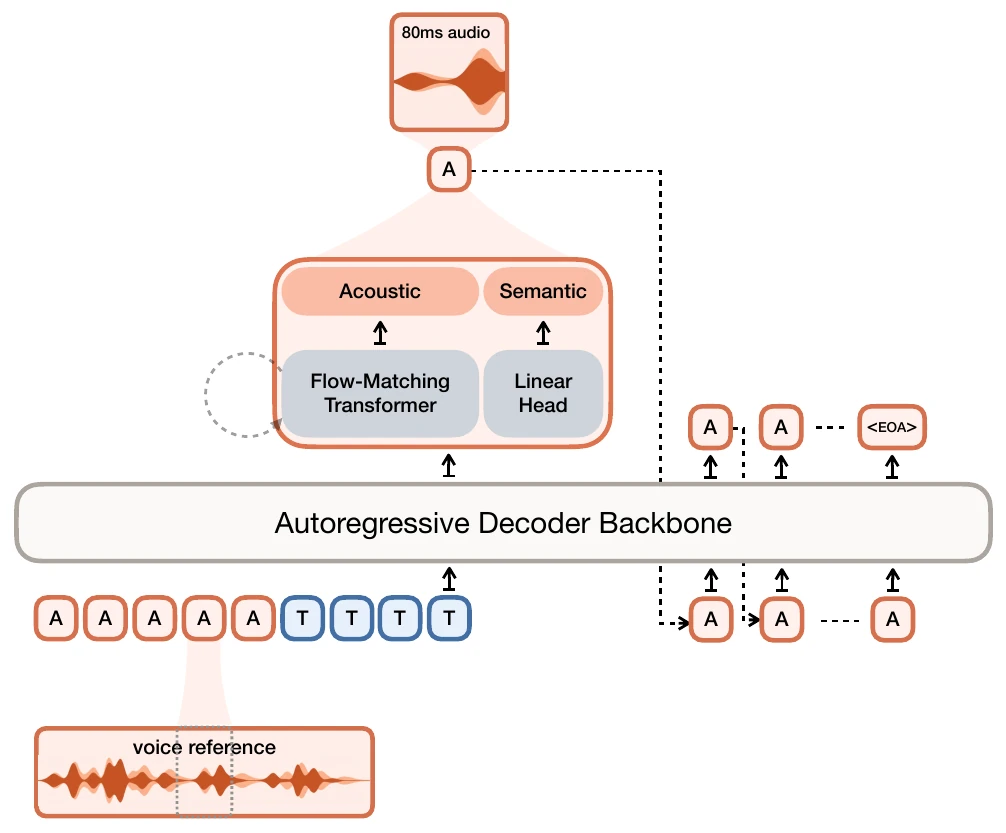
Its codec runs at 12.5 Hz and represents each frame with one 8192-entry semantic VQ token plus 36 finite-scalar-quantized acoustic coordinates. The decoder backbone generates the semantic stream autoregressively. A flow-matching acoustic head models those 36 acoustic coordinates in continuous space, runs eight NFEs by default, then discretizes the result back to the 21-level FSQ interface.
Hybrid frames combine autoregressive semantic tokens with local acoustic generation. Voxtral combines a codec representation with a flow-matching acoustic head. The semantic stream keeps a language-model-style global ordering. The acoustic head avoids making all fine acoustic detail a long sequence of categorical decisions. Streaming then becomes a coordination problem between the autoregressive semantic loop, the local acoustic generator, and the audio decoder.
Where three systems put the same residual acoustic detail
MOSS-TTS
RVQ depth within each frame.
Voxtral TTS
A per-frame flow model over local acoustic coordinates.
VibeVoice
A low-rate representation kept continuous.
Reducing sequential frame rate relocates acoustic detail into residual depth, a semantic-acoustic cascade, a local flow head, a mel-frame sampler, or a continuous latent space.
Five fields locate a TTS system
A new TTS system can be classified by five fields, shown here filled in for VibeVoice.
| Field | VibeVoice |
|---|---|
| Representation | continuous acoustic latent |
| Schedule | next-token diffusion head |
| Frame rate | 7.5 Hz |
| Acoustic detail | kept in the low-rate continuous latent |
| Metric | tokenizer ablation: PESQ and SIM-O |
The question each field asks, and what the fields separate
- Representation: what does the primary acoustic generator sample before waveform rendering?
- Schedule: which generation schedule sets the critical path?
- Frame rate: at what rate are sequential decisions made?
- Acoustic detail: where does it live when the frame rate is low?
- Metric: what tests the representation itself, not only the final audio?
These fields distinguish systems that share a frame rate, training objective, or tokenizer metric. A 12.5 Hz codec-token model and a 12.5 Hz hybrid flow model share a temporal rate, but they do not share a sampler or loss. A flow-matching mel model and a flow-matching acoustic-token head share training math, but not the sampled representation. A semantic tokenizer with strong WER is not automatically a good TTS latent. A continuous latent encoder that reconstructs well is not automatically easy for a language model to predict.
Sources
All 12 sources and what each supports
- VALL-E: discrete-codec TTS, 75 Hz EnCodec representation, eight residual codebooks, and autoregressive plus non-autoregressive codebook generation.
- Voicebox: non-autoregressive flow matching over 80-dimensional log-mel frames at 100 Hz and the NFE tradeoff for sampling.
- Matcha-TTS: optimal-transport conditional flow matching for non-autoregressive acoustic modeling.
- F5-TTS: direct non-autoregressive flow matching over 100-channel log-mel frames with Vocos as vocoder.
- CosyVoice: supervised semantic tokens, text-to-token language modeling, and flow-matching acoustic rendering.
- MaskGCT: semantic and acoustic token stages with masked generative codec Transformers.
- MOSS-TTS: low-rate 12.5 Hz codec tokens, 32 residual codebooks, and residual-depth modeling.
- Voxtral TTS: hybrid semantic-token plus finite-scalar-quantized acoustic-code architecture, Figure 2, Voxtral Codec, and per-frame flow-matching acoustic generation.
- VibeVoice: 7.5 Hz semantic and continuous acoustic tokenizers, next-token diffusion head, and tokenizer ablations.
- The WER Trap: evidence that semantic-token WER can miss generative acoustic suitability.
- LatentLM: next-token diffusion over continuous latents and low-rate speech-latent experiments.
- SemaVoice: continuous autoregressive speech synthesis and frame-rate sensitivity for continuous speech tokens.