Hear six early presidents in their own voices (1908-1922)
Taft in 1908, Roosevelt in 1912, Coolidge and FDR in 1920, Harding in 1921: public domain phonograph speeches, with Harding's 1921 address restored beside the original.
"We only wish to do with you that finer, nobler thing which no nation can do alone. We wish to sit with you at the table of international understanding and good will."
Before radio, the closest most Americans came to hearing a president was a phonograph record. This page collects five of those discs, from 1908 to 1922. Harding's 1921 address, at the top, is restored with Diffio AI, our speech restoration tool; each of the other four sections links to the original disc at the Library of Congress.
Update, November 12, 2026: we have taken the restorations of the Taft, Roosevelt, Coolidge and FDR discs off this page. On our check of whether a restored voice still matches the original speaker, those four fell short, so we link the originals instead.
Five discs, 1908 to 1922
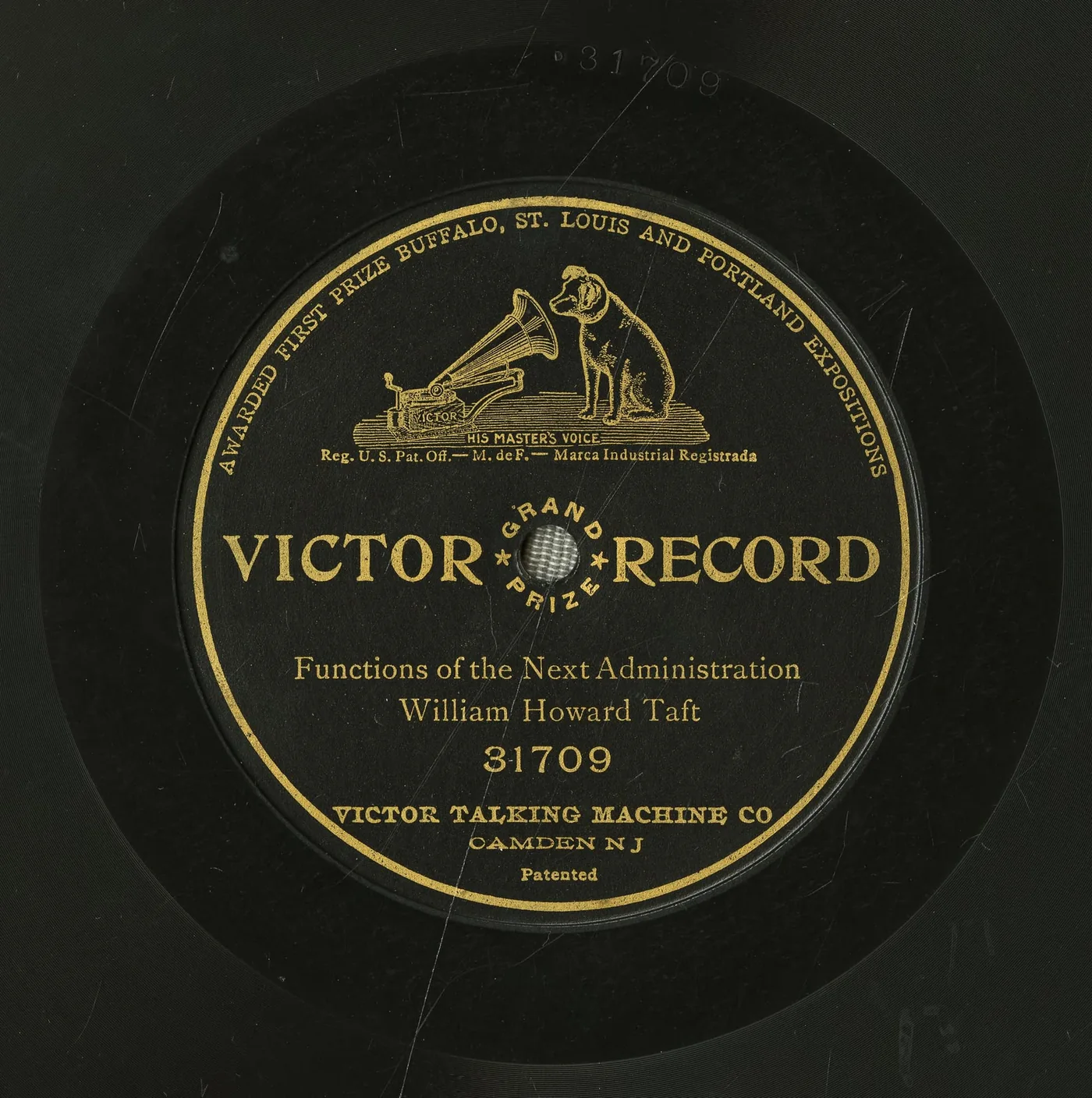
- August 5, 1908Taft, Victor 31709
- September 22, 1912Roosevelt, Victor 35250-A
- 1920Coolidge, "Law and Order", Nation's Forum
- 1920FDR, "Americanism", Nation's Forum
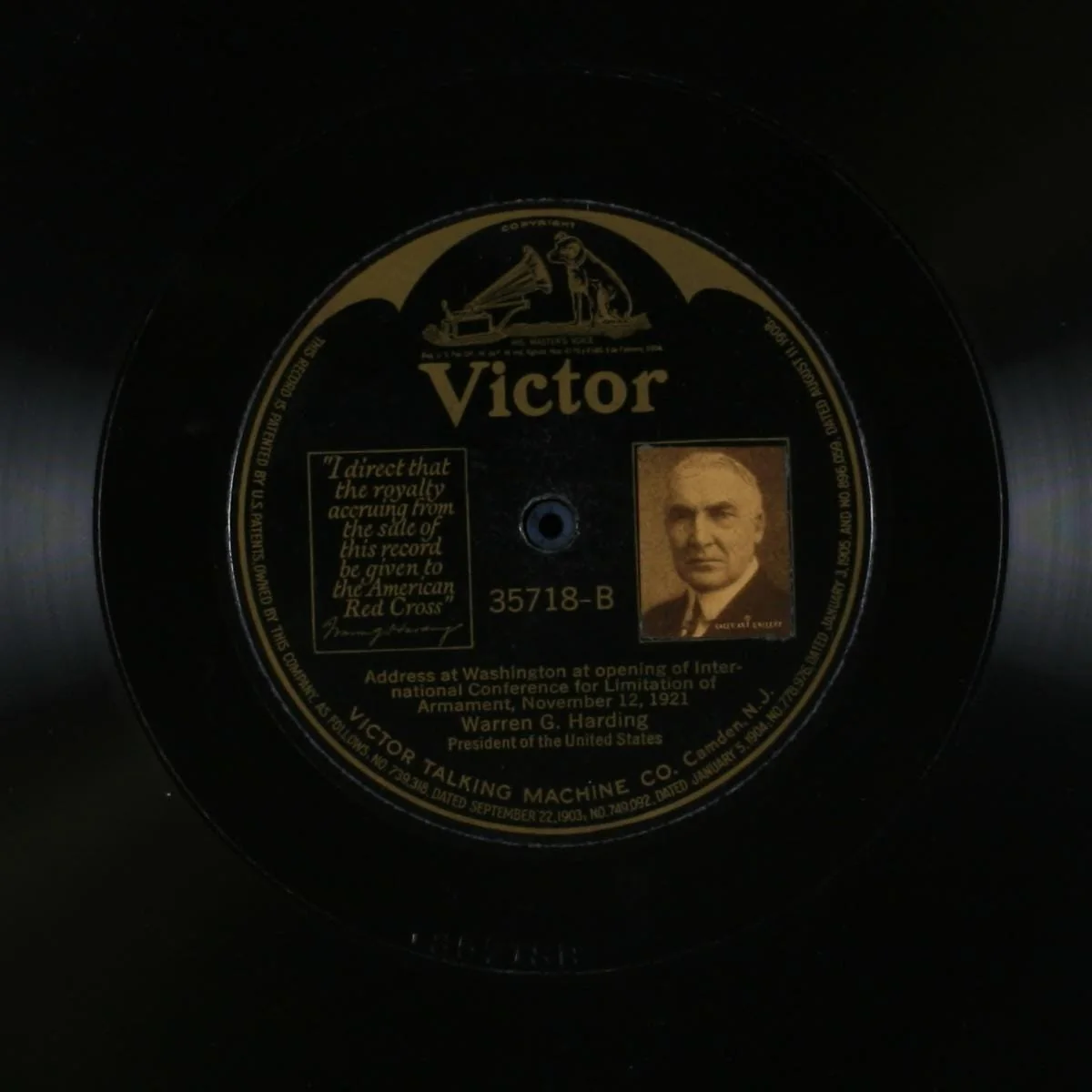
- May 24, 1922Harding, Victor 35718-B
About these discs
Between 1908 and 1922 candidates and presidents recorded short speeches for Victor and for the Nation's Forum series, made acoustically, by speaking into a horn, with no microphone. Those discs survive, but the voices sit under a century of hiss, crackle and horn resonance.
This page collects six voices from those years, from William Howard Taft in 1908 to Franklin D. Roosevelt in 1920. Harding's 1921 pair is at the top of this page, the same passage from the same disc, original first, matched for loudness. The other four discs follow below, each with a link to the original. All of the recordings were published before 1923, so they are in the public domain in the United States.
William Howard Taft, 1908: "Functions of the Next Administration"
Hot Springs, Virginia, August 5, 1908: the Republican nominee on Roosevelt's fight against lawbreaking corporations.
"The chief function of the next administration, in my judgment, is distinct from, and a progressive development of, that which has been performed by President Roosevelt."
Full transcript of this passage
"The chief function of the next administration, in my judgment, is distinct from, and a progressive development of, that which has been performed by President Roosevelt. The chief function of the next administration is to complete and perfect the machinery by which these standards may be maintained, by which the lawbreakers may be promptly restrained and punished, but which shall operate with sufficient accuracy and dispatch to interfere with legitimate business as little as possible."
Hear the original disc at the Library of Congress.
Roosevelt, Wilson and Taft, 1912
Roosevelt, the Progressive: "They dread you, the people." All three 1912 candidates are on our 1912 election page.
Hear the original disc at the Library of Congress.
Calvin Coolidge, 1920: "Law and Order"
Governor of Massachusetts, 1920, the year he was elected vice president.
"This is not paternalism, it is not a servitude imposed from without, but the freedom of a righteous self-direction from within."
Full transcript of this passage
"Government is not, must not be, a cold, impersonal machine, but a human and more human agency, appealing to the reason, satisfying the heart, full of mercy, assisting the good, resisting the wrong, delivering the weak from any impositions of the powerful. This is not paternalism, it is not a servitude imposed from without, but the freedom of a righteous self-direction from within."
Hear the original in the Library of Congress collection American Leaders Speak.
Franklin D. Roosevelt, 1920: "Americanism"
The 1920 Democratic candidate for vice president, closing on the First World War.
"To them we must write the binding finish: it shall not occur again. For America demands that the crime of war shall cease."
Full transcript of this passage
"The other half is not won yet. The cry of the French at Verdun, 'They shall not pass,' and the cheer of our own men in the Argonne, 'We shall go through,' these were essential glory. Yet they are incomplete. To them we must write the binding finish: it shall not occur again. For America demands that the crime of war shall cease."
Hear the original in the Library of Congress collection American Leaders Speak.
Warren G. Harding, 1921: opening the Washington Naval Conference
November 12, 1921, the day after he buried the Unknown Soldier; recorded for Victor in May 1922.
"We only wish to do with you that finer, nobler thing which no nation can do alone. We wish to sit with you at the table of international understanding and good will."
Full transcript of this passage
"Gentlemen of the Conference, the United States welcomes you with unselfish hands. We harbor no fears. We have no sordid ends to serve. We suspect no enemy. We contemplate or apprehend no conquest. Content with what we have, we seek nothing which is another's. We only wish to do with you that finer, nobler thing which no nation can do alone. We wish to sit with you at the table of international understanding and good will."
The restored pair is at the top of this page.
The other side, Harding's Hoboken address, has its own page.
Sources and use
| Clip | Disc | Source |
|---|---|---|
| Taft, 1908 | Victor 31709 | LoC |
| Roosevelt, 1912 | Victor 35250-A | LoC |
| Coolidge, 1920 | Nation's Forum | IA, LoC |
| FDR, 1920 | Nation's Forum | IA, LoC |
| Harding, 1921 | Victor 35718-B | LoC |
Free to play, embed or link. Credit: "Original: [label], [year]; restored with Diffio AI (diffio.ai)".
Where the discs come from, why they are public domain, and the stories behind them
The Taft, Roosevelt, Wilson and Harding discs come from the Library of Congress National Jukebox, through its Internet Archive copies. The Coolidge and Roosevelt 1920 records come from Internet Archive copies of the Nation's Forum series, which the Library of Congress also holds in its American Leaders Speak collection. Sound recordings published before 1923 entered the public domain in the United States in 2022 under the Music Modernization Act. LoC is the Library of Congress (National Jukebox for the Victor discs, American Leaders Speak for the Nation's Forum records); IA is the Internet Archive copy.
Teachers, librarians, museums and writers are welcome to play, embed or link any of these clips. If you need the full restored Harding disc or WAV files, write to nathan.harmon@diffio.ai.
Taft, 1908. Taft recorded a set of campaign speeches for Victor at Hot Springs, Virginia, on August 5, 1908, while he was the Republican nominee. In this one he promises to carry on Theodore Roosevelt's fight against lawbreaking corporations.
Roosevelt, Wilson and Taft, 1912. In the fall of 1912 all three candidates recorded for Victor. Roosevelt, running as a Progressive, answered the trusts and party bosses: "They dread you, the people." Wilson took apart Roosevelt's plan to regulate monopoly, and Taft, now the sitting president, asked "Who are the people?" All three discs, with their labels, are on the 1912 election page.
Coolidge, 1920. Coolidge recorded "Law and Order" for the Nation's Forum series in 1920 as governor of Massachusetts, the year he was elected vice president. It is one of the earliest recordings of his voice.
Franklin D. Roosevelt, 1920. Twelve years before he was elected president, Roosevelt was the Democratic candidate for vice president. According to the FDR Library, his Nation's Forum record, "Americanism," gives excerpts from the speech accepting that nomination at Hyde Park on August 9, 1920. It closes on the First World War.
Harding, 1921. On November 12, 1921, the day after he buried the Unknown Soldier at Arlington, Harding opened the Washington Conference on the Limitation of Armament. He recorded the address for Victor in May 1922, on the other side of the disc that carries his Hoboken address over 5,212 American war dead, and directed that the royalties go to the American Red Cross.
The same restoration works on recordings much closer to home: a parent's voice on an old cassette, a lecture recorded at the back of a hall, an interview with a noisy room behind it. You can try Diffio on your own recordings.