Hear Warren G. Harding's 1921 Hoboken address for the WWI dead, restored
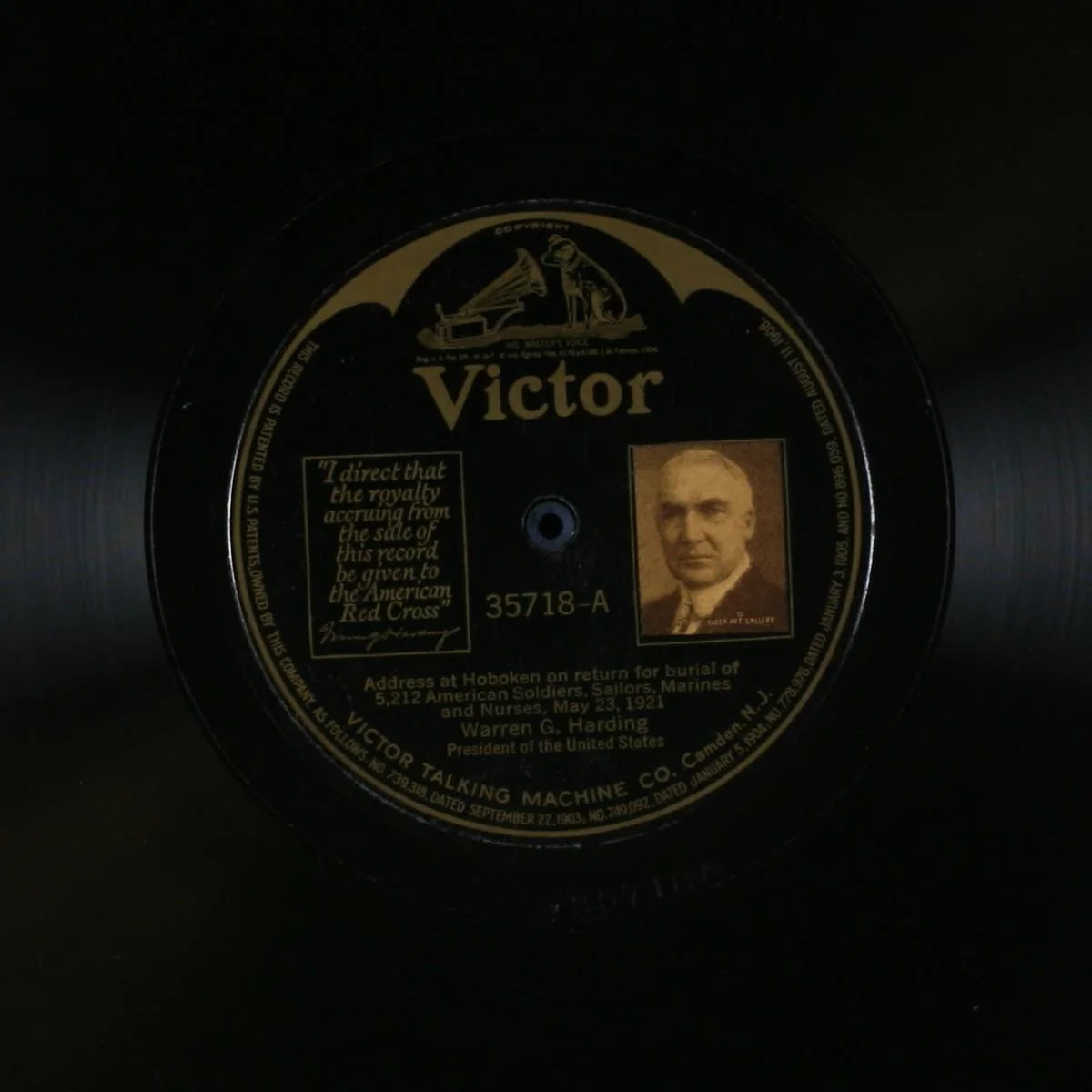
Warren G. Harding's 1922 recording of his Hoboken address for 5,212 American war dead, before and after restoration with Diffio AI.
"I find a hundred thousand sorrows touching my heart, and there is ringing in my ears, like an admonition eternal, an insistent call, 'It must not be again. It must not be again.'"
Full transcript of this passage
"One's words fail, his understanding is halted, his emotions are stirred beyond control when contemplating these thousands of beloved dead. I find a hundred thousand sorrows touching my heart, and there is ringing in my ears, like an admonition eternal, an insistent call, 'It must not be again. It must not be again.' God grant that it will not be, and let a practical people join in cooperation with God to the end that it shall not be."
On May 23, 1921, President Warren G. Harding stood on Pier 4 in Hoboken, New Jersey, beside the coffins of 5,212 Americans who died in the First World War. For Veterans Day we ran his recording of that address through Diffio AI, our speech restoration tool: the same 35 seconds, original and restored, matched for loudness.
From Pier 4 to the record
- May 1921Hoboken, 5,212 war dead
- Nov 1921the Unknown Soldier
- May 1922recorded at the White House
- Nov 1922Victor disc, for the Red Cross
- 2022public domain
Where the recording comes from
The 5,212 Americans had just been brought home. Harding spoke in Hoboken on May 23, 1921, and buried the Unknown Soldier at Arlington on November 11, 1921. A year and a day after the Hoboken address, on May 24, 1922, Harding spoke the same address into a recording horn at the White House. Victor released the disc that November, with the proceeds going to the Red Cross.
That disc survives, digitized by the Library of Congress for its National Jukebox. It is an acoustic recording, made without a microphone, and a century of surface noise sits on top of it: a roar of hiss and crackle with Harding's voice somewhere underneath. U.S. recordings published before 1923 entered the public domain in 2022.
What restoration changed on Harding's 1922 disc
What you hear
Original
A roar of hiss and crackle, with Harding's voice somewhere underneath.
Restored
The surface noise drops away and his voice comes forward.
Watch: 20 seconds, before and after
The full address
The whole 4 minute 25 second disc:
Correction, November 3, 2026: about 3:27 into the full restoration one passage comes out garbled. Quote Harding from the original.
The full correction, and what the disc leaves out
Correction (November 3, 2026): checking the full restoration word by word against the original disc, we found one passage the model got wrong. About 3 minutes 27 seconds in, Harding says "of a nation being so righteous as never to"; the words are clear on the original, but in the restored file they come out garbled, closer to "even". Changed words are a failure, not how Diffio is meant to work, and it is why the original stays the reference: quote Harding from the original, not the restoration. The 35-second excerpt above does not include this passage, and we checked it against the published text.
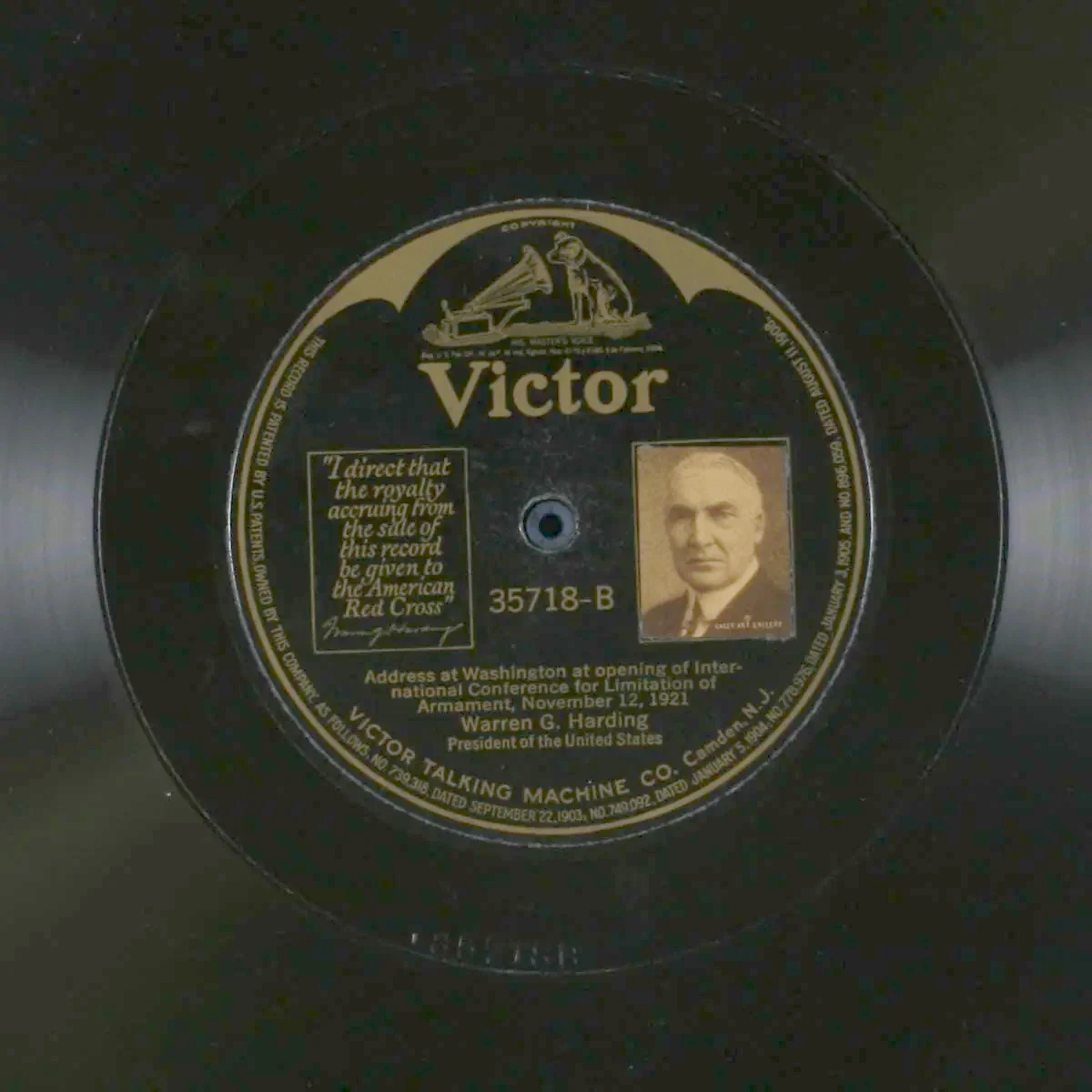
The 1922 recording is a little shorter than the speech Harding gave in Hoboken. A short passage near the end ("They gave all which men and women can give...") is not on the disc; the Library of Congress prints the full text with the omitted lines marked. The other side of the disc (Victor 35718-B, Harding opening the Washington Naval Conference) is on our early presidents page. Label images: Library of Congress National Jukebox.
Six months later: the Unknown Soldier
On November 11, 1921, the third anniversary of the armistice, Harding presided at the burial of the Unknown Soldier at Arlington National Cemetery.
The anniversary, and why this address matters
This Veterans Day marks 105 years of the Tomb. The Hoboken address is the closest thing we have to hearing him speak about the war dead in his own voice, and the line at its center, "It must not be again," is one that every generation since has had reason to repeat.
For journalists, educators and museums
Public domain in the US: a sound recording published before 1923. Credit: Library of Congress National Jukebox; restored with Diffio AI. WAV files: nathan.harmon@diffio.ai.
Rights, the full credit line, and how we restored it
| Reuse | Details |
|---|---|
| Original | Warren G. Harding, Victor 35718-A (1922), Library of Congress National Jukebox |
| Rights | Public domain: first published in 1922, and U.S. sound recordings published before 1923 entered the public domain in 2022 |
| Credit line | "Audio: Warren G. Harding, Victor 35718-A (1922), Library of Congress National Jukebox; restored with Diffio AI (diffio.ai)" |
| WAV files | Write to me at nathan.harmon@diffio.ai |
Diffio restores recorded speech. It separates the voice from everything else in the recording and takes the noise away, so the voice sounds closer to a clean microphone.
Diffio is built to stay faithful to the original: the same person, the same voice and the same words. A changed word or a different-sounding voice is a failure, not how it works, and that is one reason we publish the original next to the restoration. We treat the restored file as a listening copy: the original stays exactly as the Library of Congress digitized it, and anyone quoting Harding should check the words against it and against the published text.
Please use the credit line above when you publish the restored audio or the video.
The same restoration works on a grandfather's service cassette or an oral history taped in a noisy hall: try Diffio on three uploads.
Nathan Harmon is the founder of Diffio AI, based in Colorado Springs.