Agatha Christie in her own voice, 1955: hear it restored
Agatha Christie on why she started writing and how she worked, from the BBC's 1955 radio portrait, before and after restoration with Diffio AI, for the centenary of her eleven missing days.
Agatha Christie gave very few interviews. In 1955 the BBC recorded her at her London flat for a radio portrait, Agatha Christie in Close-Up, and in it she explains, in her own voice, how she came to write at all. We ran 90 seconds of that recording through Diffio AI; the original sits beside the result.
On December 3, 1926, Christie left her home in Sunningdale late at night, and her car was found abandoned the next day at Newlands Corner, near Guildford. She was found eleven days later, on December 14, at the Swan Hydropathic Hotel in Harrogate, registered as Mrs Teresa Neele. The Surrey police report on the search is at the National Archives. December 2026 is the centenary of those eleven days.
How to compare the original and restored recording
Before you listen
- Matchedboth files have the same loudness, so neither wins by being louder
- Excerpt90 seconds, from "You see, I put it all down" to "until it comes right"
- Tonethe restored voice is brighter than the original, so more than the noise changes
About our source
We worked from the BBC's own upload of the interview, A rare interview with the elusive Agatha Christie, on its BBC Global channel, which accompanies BBC Culture's January 2026 feature on the recording. It is a copy of a web file, not a BBC master, so what you hear in the original is the recording's age and the file's compression together. A speech quality model (SCOREQ) reads the original at 2.95 out of 5 and the restored file at 4.52.
"There's nothing like boredom to make you write"
"Although I was gloriously idle, in those days children had to do a good many things for themselves. But I found myself making up stories and acting the different parts, and there's nothing like boredom to make you write."
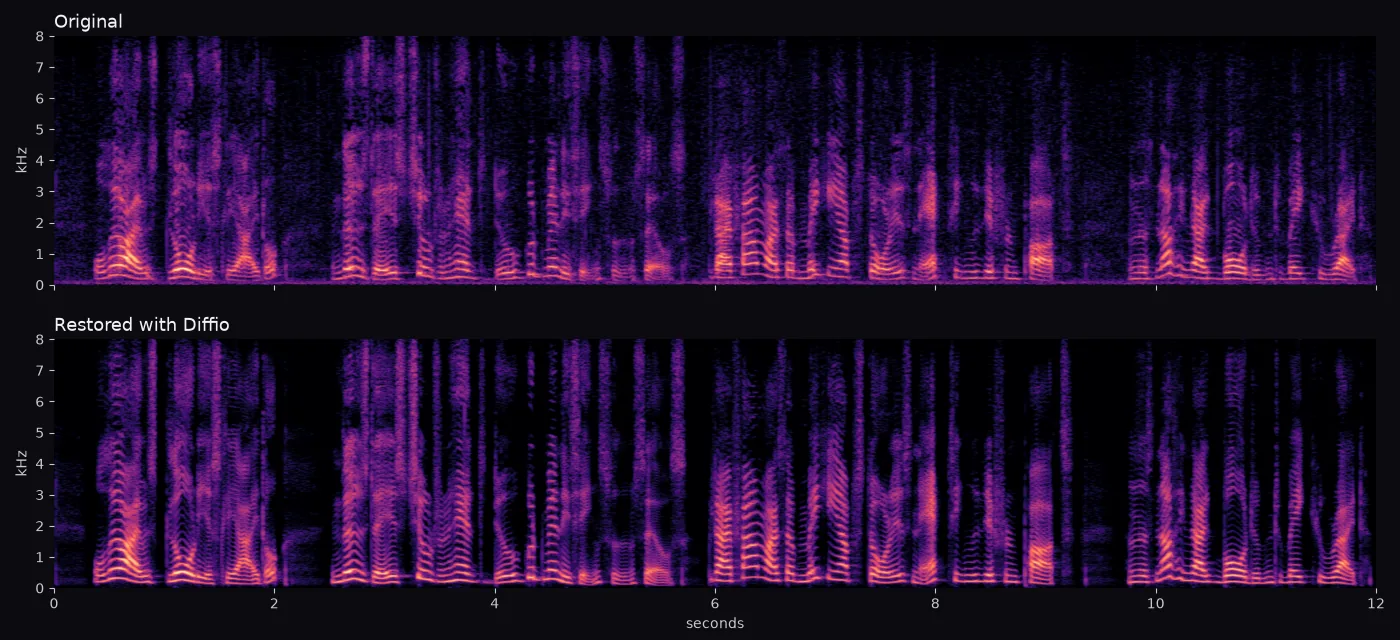
How to read the spectrogram
Twelve seconds of the recording, from "gloriously idle" to "nothing like boredom to make you write", original above and restored below. Time runs left to right, pitch rises from bottom to top, and brighter means louder. In the original, noise fills the space between her words; after restoration that space goes dark.
She puts it all down, she says, to never having had an education: no lessons to speak of until she went to school in Paris at about 16. By 21 she had finished The Mysterious Affair at Styles, the first of her books to be published. It went to one or two publishers who didn't want it before John Lane took it, and "about a year later I heard it had been accepted."
"An ancient faithful machine"
"I type my own drafts on an ancient faithful machine I've owned for years, and I find a dictaphone useful for short stories or for recasting an act of a play, but not for the more complicated business of working out a novel."
The real work, she says, "is done in thinking out the development of your story and worrying about it until it comes right."
For journalists, educators and museums
Link this page and credit the BBC for the recording.
Credit line and questions
| Reuse | Details |
|---|---|
| Source | BBC Culture: A rare interview with the elusive Agatha Christie |
| Credit line | "Recording: BBC; restored with Diffio AI (diffio.ai)" |
| Questions | Write to me at nathan.harmon@diffio.ai |
Another broadcast from those years: hear Edward VIII's abdication broadcast of December 11, 1936, restored.