The day after Pearl Harbor, in Americans' own voices: 1941 street interviews, restored
On December 8, 1941, the Library of Congress asked fieldworkers across the US to record what ordinary people thought of the war.
On December 8, 1941, the day after Pearl Harbor, Alan Lomax of the Library of Congress asked fieldworkers in ten places to record what ordinary people were saying. For the 85th anniversary we restored twelve excerpts with Diffio AI, each beside its original.
Part one, December 1941: Denver · Nashville · Dallas · Austin · Buffalo · Madison · New York · Washington
Part two, early 1942, "Dear Mr. President": Minneapolis · Detroit · Tucson · Pittsburgh
Every recording, with its date and disc
Part one, December 1941: the first days
| City | Recorded | Disc |
|---|---|---|
| Denver | December 9, 1941 | AFS 6453A |
| Nashville | December 1941 | AFS 6361A |
| Dallas | December 1941 | AFS 6373A |
| Austin | December 9, 1941 | AFS 6370A |
| Buffalo | December 1941 | AFS 6454A |
| Madison | December 9, 1941 | AFS 6367A |
| New York | December 8, 1941 | AFS 6362A |
| Washington | December 8, 1941 | AFS 6357B |
Part two, January and February 1942: "Dear Mr. President"
| City | Recorded | Disc |
|---|---|---|
| Minneapolis | Early 1942 | AFS 6416A |
| Detroit | January 13, 1942 | AFS 6415A |
| Tucson | Early 1942 | AFS 6446A |
| Pittsburgh | Early 1942 | AFS 6458A |
About the collection and how the pairs are matched
Lomax sent the request by telegram. The fieldworkers carried disc recorders to theater fronts, campuses and radio studios, and within days they had about four and a half hours of Americans reacting to a war that had just begun.
The discs survive at the Library's American Folklife Center, published as After the Day of Infamy. They are extraordinary, and they are hard to listen to: a shooting gallery bangs behind the interviewers in Washington, car horns cut across answers, and surface noise sits on all of it.
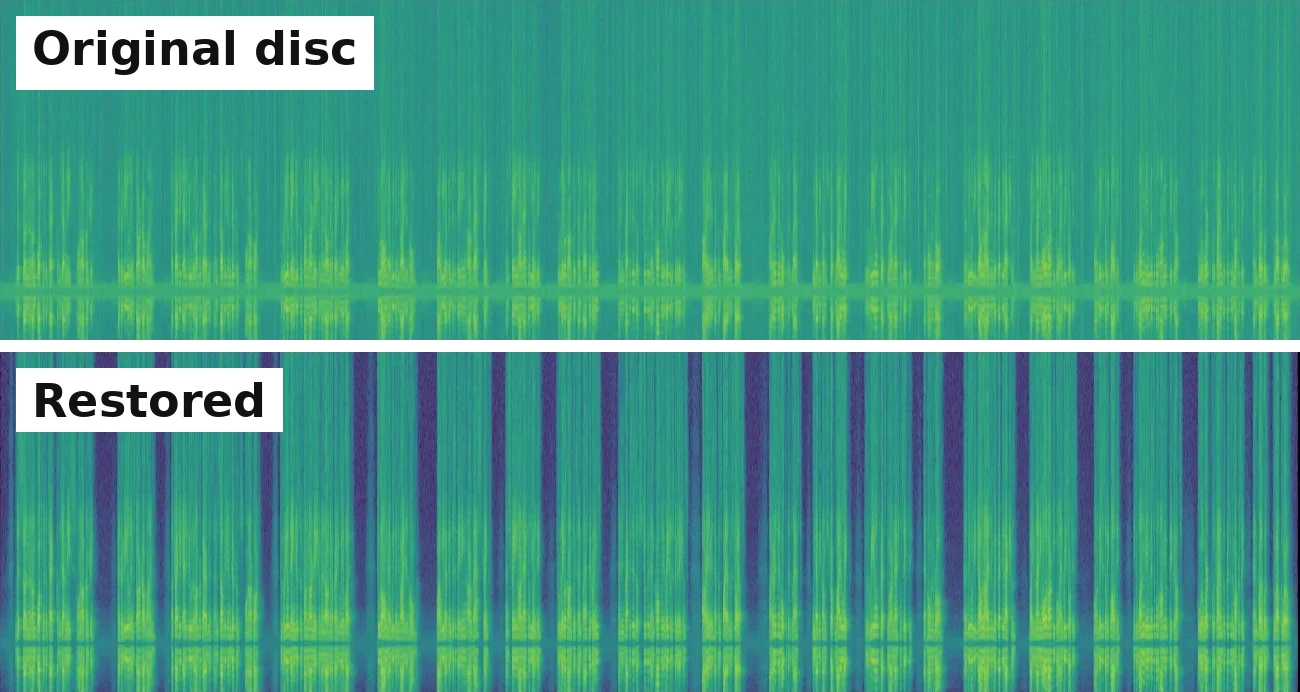
Eight excerpts come from those first days, and four from a second series recorded weeks later. Each pair is matched for loudness, so neither file wins by being louder. More than the noise can change: some restored voices are measurably brighter than the original, so listen to both. The pair at the top is the Reverend W. J. Faulkner in Nashville; the other eleven follow below.
Denver: "I'm going to enlist"
Howard Belker, 27, a taxi driver, Duncan Emrich's first interviewee on December 9, 1941.
"I had a good night sleep last night and I ate well today and I'm going to continue to do so."
Then: a plan to enlist and fly, and a hope that "we never have another one."
Nashville: "Too long have we been divided at home"
The Reverend W. J. Faulkner, Nashville NAACP president, on "stupid and costly racial discriminations."
Dallas: "Hatred is death, but love is life"
Lena Jameson, 80, visiting her children; recorded by John A. Lomax, Alan's father.
"I find myself at the age of eighty, an old woman, hanging on to the tail of the world, trying to keep up. I do not want the driver's seat."
Austin: "The out-fightin-ist people on earth"
J. C. Brodie, drawn out by John Henry Faulk on December 9, 1941.
Buffalo: a radio station's microphone
William Patterson, 22, just out of Brown University, at station WBEN.
Madison: "When a sneak hits us"
The director of a private business school, December 9, 1941; the Library lists the name as unknown.
New York: a shoemaker hears the president
Luis Andrew, a shoemaker, just after the president's speech: small nations as a laborer afraid of the boss.
Washington: outside the Palace Theater
A man classified 1-A for the draft, at 13th and F Streets, about 9 p.m. on December 8. Names are withheld, as the Library withholds them.
Weeks later: "Dear Mr. President"
In early 1942 a second series asked people to speak directly to President Roosevelt.
Minneapolis: "Keep up the good work, Pop"
John Leo, a University of Minnesota janitor, days from his draft answer.
Detroit: "You can count on us"
Robert Clark for Detroit's radio industry, January 13, 1942, a new aviation cadet.
Tucson: "My fighting blood up"
Carlos Lopez, about to enlist in the Marines, for "the Spanish people born in the United States."
Pittsburgh: "A good friend of ours"
Mrs. William Houghton, a mother of two, thanks the president for a job, a home and a training course.
The speakers and interviewers, in full
Duncan Emrich, who later headed the Library's folklore archive, set up a microphone in Denver on December 9, 1941, the day after Congress declared war on Japan. The first interviewee was Howard Belker (the Library's spelling), 27, a taxi driver who had spent most of those years in Denver.
Belker then tells Emrich about years of flying, a plan to enlist and fly in this war, and a hope that afterward "we never have another one."
The Nashville series was made by Charles S. Johnson and Lewis Jones. The Reverend W. J. Faulkner, a Congregational minister and president of the Nashville branch of the NAACP, used the moment on the disc to name what the attack had exposed: "practices of stupid and costly racial discriminations," and the hope of uniting all people and resources "on a basis of equality." In the spectrograms, time runs left to right, pitch rises from bottom to top, and brighter means louder.
John A. Lomax, Alan's father and a collector of American song, recorded Lena Jameson of Redondo Beach, California, while she was visiting her children in Dallas. She was 80.
The interviewer here is John Henry Faulk, later a radio host who was blacklisted in the 1950s and won a landmark libel case over it. On December 9, 1941 Faulk was collecting opinions around Austin, and drew this out of J. C. Brodie.
In Buffalo the interviews went through "the facilities of WBEN, the Buffalo Evening News station," with Charles Harrell asking the questions. William Patterson, 22, had just finished at Brown University.
Leland Coon's Madison series, recorded December 9, 1941, has an announcer introducing each speaker by role. The Library lists these speakers' names as unknown. This one is the director of a private business school.
Charles Todd and Robert Sonkin recorded New Yorkers on December 8, 1941. Luis Andrew, a shoemaker, had just heard the president's speech. Andrew compares the small nations of the world to a laborer afraid of the boss.
Alan Lomax and Philip Cohen worked the sidewalk themselves. This man spoke to them in front of the Palace Theater at 13th and F Streets, about 9 p.m. on December 8, with traffic behind him. He was classified 1-A for the draft.
The interviewers told some Washington speakers that their words would not be broadcast, and the Library removed interviewee names from its Washington recordings for that reason. Our excerpt leaves his name out too.
In January and February 1942 a second series went out, under the Office of Emergency Management: people were asked to speak directly to President Roosevelt. A selection became a radio program, "Dear Mr. President," broadcast that May.
John Leo, a janitor at the University of Minnesota, was days from learning whether the next uniform would be khaki.
On January 13, 1942, Robert Clark spoke for Detroit's radio industry, and mentioned having just been accepted as an aviation cadet.
Carlos Lopez, recently discharged from the Army and about to enlist in the Marines, spoke for "the Spanish people born in the United States" as well as for himself.
Mrs. William Houghton, a housewife with two small children, thanked the president for what the government had meant to one family: a job after repeal of the Eighteenth Amendment, a place in a government housing project, a defense training course.
What these are, and what they aren't
Excerpts chosen for clarity; hear the full collection with the Library's transcripts.
How we restored and checked these excerpts, and what didn't pass
These are excerpts, chosen for clarity and for what the speakers say. The full collection should be heard whole, and the Library's transcripts are the place to start.
Not everything passed. An Indiana University student discussion recorded in Bloomington on December 10, 1941 did not meet our bar for keeping the voices faithful, so it isn't here.
The full collection holds a wider range of opinion than this page, including racial slurs and anger that were common in December 1941.
Diffio restores recorded speech. It separates the voice from everything around it and takes the noise away, and it is built to keep the same person, the same voice and the same words. We checked each excerpt here with a speech recognizer against the original and measured how close the voice stayed to the source. Automated checks are not proof, so treat these files as listening copies and check any quotation against the original disc and the Library's transcript.
The Bloomington recording has several voices around one microphone. You can hear the original at the Library.
Using these recordings
Free for newsrooms, teachers and stations. Credit: American Folklife Center, Library of Congress; restored with Diffio AI.
Rights, the full credit, and your own archive
Newsrooms, teachers and stations are welcome to use our restored excerpts.
| Reuse | Details |
|---|---|
| Rights | The Library of Congress says it is not aware of any U.S. copyright protection or other restrictions on this material apart from a few listed songs, none of which are used here |
| Credit | The American Folklife Center, Library of Congress, for the recordings; Diffio AI for the restoration |
| Your own archive | To have a recording restored for the anniversary, write to nathan.harmon@diffio.ai |