Santa Claus on 1921 phonograph records: hear him restored
Two Santa Claus records made in 1921, Harry E. Humphrey's "Santa Claus Hides in Your Phonograph" for Edison and Gilbert Girard's "Santa Claus Visits the Children" for Victor, before and after restoration with Diffio AI.
In 1921 two record companies put Santa Claus inside the family phonograph. In New York on October 4, Harry E. Humphrey recorded "Santa Claus Hides in Your Phonograph" for Edison. In July, Gilbert Girard had recorded "Santa Claus Visits the Children" for Victor. We ran both records through Diffio AI; each original sits beside its result.
How to compare the original and restored records
Before you listen
- Matchedboth files have the same loudness, so neither wins by being louder
- Speech onlyDiffio keeps the voice and moves everything else to a background track, so Santa's laughs, the chimes on the Edison record and the meows on the Victor record are quiet or gone in the restored files
- Two recordsHumphrey's Edison disc at the top of this page, then Girard's Victor disc
About our sources
Both transfers are from the University of California, Santa Barbara Library. The Edison disc is on the Internet Archive and in the Discography of American Historical Recordings, which dates the recording to October 4, 1921. The Victor disc is in the Library of Congress National Jukebox, which dates it to July 14, 1921. A speech quality model (SCOREQ) reads the Edison record at 1.5 out of 5 in the original and 4.5 restored, and the Victor record at 1.5 and 4.3.
Edison: "I hide in this phonograph"
Humphrey's Santa opens with a riddle for the children in the room, then lets them in on it.
"Hush, close all the doors and I'll tell you a secret. I'm old Santa Claus."
He explains why he stays in the box: his whiskers and his red robe are black from climbing down so many chimneys, and he must take a warm bath before he can come out and greet them. Then he plays a tune on his chime, squeezes out of the phonograph and calls to Prancer. The chime tune is the half minute or so that goes quiet in the restored file.
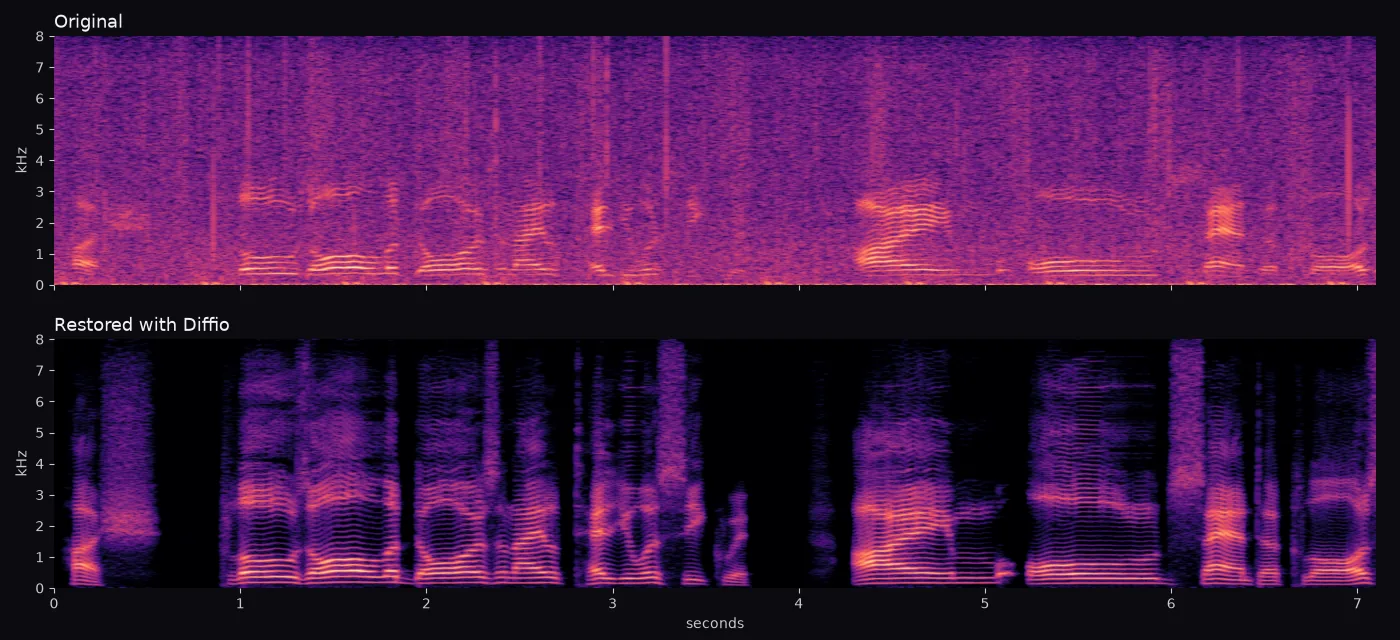
How to read the spectrogram
Seven seconds of the Edison record, from "close all the doors" to "I'm old Santa Claus", original above and restored below. Time runs left to right, pitch rises from bottom to top, and brighter means louder. In the original, surface noise fills the space between his words; after restoration that space goes dark.
Victor: Santa reads Mother Goose
"Come, children, gather near, a few nice stories you shall hear."
Girard's Santa sits the children in a circle and reads from a book of nursery rhymes: "Hey Diddle Diddle", "Sing a Song of Sixpence", "Little Boy Blue" and "Ding Dong Bell", with a cat meowing along. The Library of Congress writes that Girard made a series of Santa Claus records for children from 1918 until 1922, and that Victor promoted them heavily each holiday season. He was known for his animal imitations. In the restored file the meows go with the background.
For journalists, educators and museums
Link this page and credit the UCSB Library for the transfers.
Credit line and questions
| Reuse | Details |
|---|---|
| Edison source | Internet Archive: Santa Claus Hides In Your Phonograph |
| Victor source | Library of Congress National Jukebox: Santa Claus visits the children |
| Credit line | "Recordings: UCSB Library; restored with Diffio AI (diffio.ai)" |
| Questions | Write to me at nathan@trydiffio.com |
The same kind of restoration works on recordings closer to home: a grandparent reading a story onto a cassette, a holiday message on an old answering machine tape, a school concert taped from the back of the hall. You can hear the result on three free uploads at diffio.ai.
Nathan Harmon is the founder of Diffio AI, based in Colorado Springs.