FDR's "Day of Infamy" speech, December 8, 1941: hear it restored
Roosevelt's war message to Congress, restored from the FDR Library's recording at the National Archives.
Excerpt · before and after · the whole recording is belowOpen it in the Diffio Library
Roosevelt's address to Congress on December 8, 1941, as the FDR Library holds it, restored: Speaker Rayburn's introduction and the whole address. Switch to the original at any moment to hear the 1941 recording untouched. Every number on this page was measured on these files.
Roosevelt spoke to a joint session of Congress the day after the attack on Pearl Harbor. The address was broadcast live on radio and runs about seven minutes in this recording.
Before you listen
- Matchedboth files have the same loudness, so neither wins by being louder
- Wholethe Speaker's introduction at 0:04, Roosevelt from 0:38 to the last word at 7:40
"Yesterday, December 7, 1941, a date which will live in infamy, the United States of America was suddenly and deliberately attacked by naval and air forces of the Empire of Japan."
Measured: the restored recording against the original
| Measure | Original | Restored | What it means |
|---|---|---|---|
| Speech quality (SCOREQ, 1 to 5), Roosevelt's address | 1.96 | 4.53 | A model's estimate of how clean and natural the speech sounds |
| Speech quality (SCOREQ), whole file | 1.84 | 4.47 | Includes the applause the restoration removes |
| Noise in the pauses (at equal loudness) | -51.8 dBFS | -105.8 dBFS | Broadcast hiss between words |
| Noise below the speech | 26.7 dB | 83.2 dB | Bigger is quieter |
| Words that differ from the official text (a speech recognizer, Roosevelt's 518 words) | 4.25% | 1.74% | Lower is better |
| Same, a second recognizer | 2.32% | 1.74% | Lower is better |
| Words added by the restoration | 0 | Nothing invented | |
| Voice match (speaker similarity, 0 to 1) | 0.67 | The library accepts 0.65 and up |
Does it still sound like Roosevelt?
Our voice-match score estimates how much the restored voice sounds like the same person as in the original, from 0 to 1. It reads 0.67 here. That clears the 0.65 we require for every recording in our library, but only just, so it's a fair question. The score is lowest (0.52) in the opening half minute, Rayburn's introduction and Roosevelt's first lines, and higher through the rest of the address. It is an estimate, not proof: play the original next to it and judge for yourself.
How to read the spectrogram
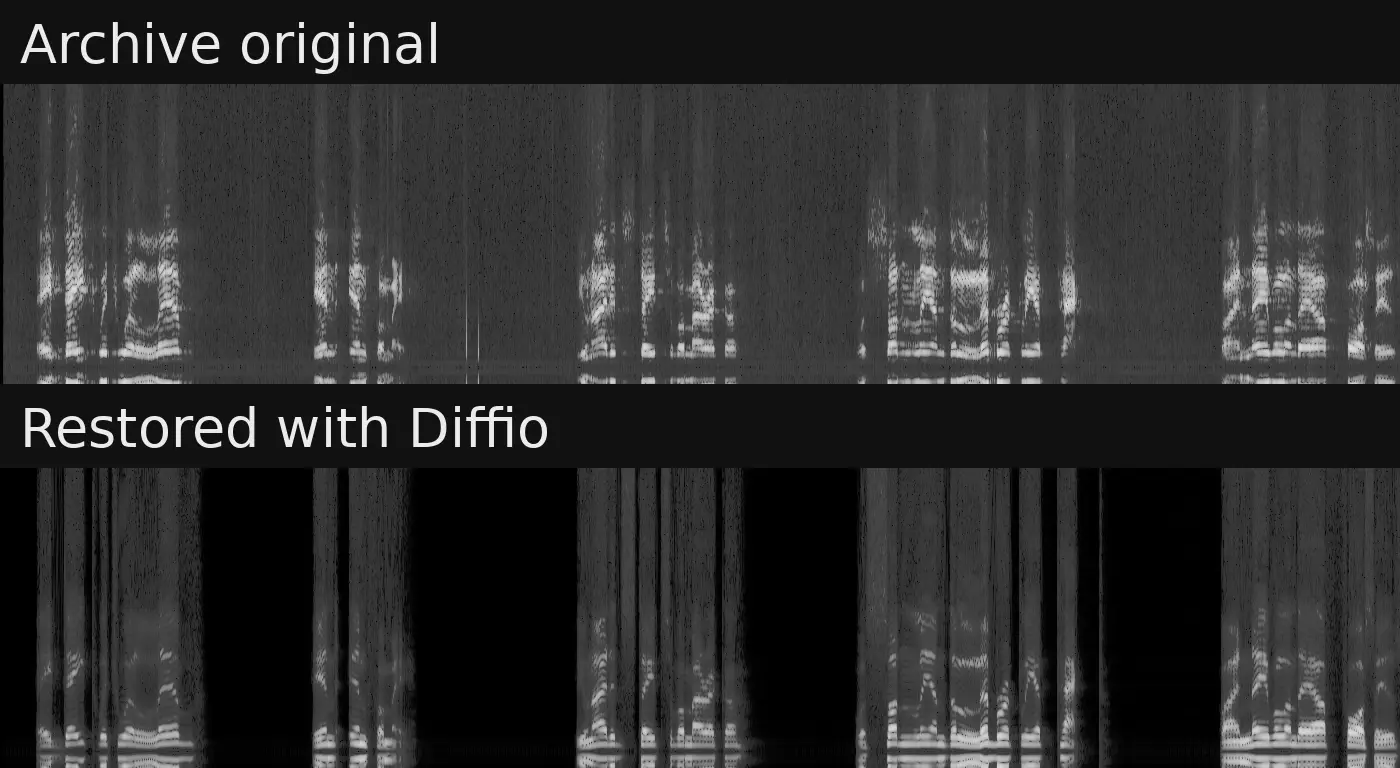
Fourteen seconds from "a date which will live in infamy", original above and restored below. Time runs left to right, pitch rises from bottom to top, and brighter means louder. In the original, broadcast hiss fills the space between his words; after restoration that space goes dark.
Did the restoration change any words?
We compared transcripts of both files with the official text. The restoration added no words, and every word of Roosevelt's is in the restored file.
The one phrase that may have changed
In the salutation (0:44), speech recognizers hear the original as "members of the Senate, of the House" and the restored file as "members of the Senate and the House". The official text reads "Members of the Senate and House". Elsewhere the restored file matches the official text where recognizers mishear the noisy original, for example "the Japanese attacked Midway Island" (4:05).
Source, rights and how it was restored
About our source
National Archives catalog item NAID 27500611, "Washington, DC - Address to Congress asking State of War to be declared", December 8, 1941, held by the Franklin D. Roosevelt Library in Hyde Park, New York (Franklin D. Roosevelt Audio Recordings, FDR-Audio 73:11). The catalog lists its use as Unrestricted. The archive file is a 22-minute radio broadcast (MP3, 128 kbps, mono). We restored the part from Speaker Rayburn's introduction to the end of the address and its applause (12:30 to 20:16 in the archive file), and trimmed only the start and the end.
How it was restored
Diffio 4.7 Pro over the whole address. For one sentence at 4:09 ("Japan has therefore undertaken a surprise offensive") we used Diffio's restoration of the National Archives' other recording of the same broadcast (Sound Recording 201.49), matched in speed, level and tone, because the restoration of this copy dropped three of its words. We checked the transcript against the official text from The American Presidency Project (UCSB).
For journalists, educators and museums
Public domain: the address is the work of the U.S. President in office, and the National Archives lists this recording as unrestricted for use. The broadcast commentary before and after the address isn't in our file.
Downloads, credit line and questions
| Reuse | Details |
|---|---|
| Restored | MP3, 7:46 |
| Original | MP3, the same 7:46 at the same loudness |
| Complete archive file | National Archives catalog item 27500611 |
| Text | The American Presidency Project: Address to Congress Requesting a Declaration of War with Japan |
| Credit line | "Recording: Franklin D. Roosevelt Library, National Archives; restored with Diffio AI (diffio.ai)" |
| Questions | Write to me at nathan@trydiffio.com |
The same kind of restoration works on recordings closer to home: a grandfather's cassette, a reel of a town meeting, an oral history taped in a noisy hall. You can hear the result on three free uploads at diffio.ai.
Questions
Is this the real recording?
Yes. It is the FDR Library's recording of the address, held by the National Archives, restored. Roosevelt's words are his. The restoration removes broadcast noise and applause. The untouched original is on this page and at the National Archives.
Can I download and reuse it?
Yes. The address is public domain and the National Archives lists the recording as unrestricted. Please credit "Franklin D. Roosevelt Library, National Archives; restored with Diffio AI (diffio.ai)".
Who introduces the President?
The Speaker of the House, Sam Rayburn, at 0:04. The recording doesn't name him.
Is there another recording?
Yes. The National Archives also holds Sound Recording 201.49 (NAID 1436350), with the radio announcer on the President's arrival and the national anthem after the address.
More from the same weeks: Roosevelt's fireside chat the next evening, December 9, 1941, and FDR on the first Bill of Rights Day, December 15, 1941.
Nathan Harmon is the founder of Diffio AI, based in Colorado Springs.