FDR welcomes WKIP Poughkeepsie, 1940: hear it restored
On August 19, 1940, Franklin D. Roosevelt spoke from his study at Hyde Park to welcome WKIP, Dutchess County's new radio station, and wondered aloud what KIP means.
On the evening of August 19, 1940, President Franklin D. Roosevelt spoke from the study of the Summer White House at Hyde Park, New York, over WKIP in Poughkeepsie, the radio station that had gone on the air that June. Judge John E. Mack introduced him as Dutchess County's finest son. Roosevelt then welcomed the station, a little late by his own account, and tried to work out what its call letters meant. We ran passages of his talk through Diffio AI; each original sits beside its result.
How to compare the original and restored talk
Before you listen
- Matchedboth files have the same loudness, so neither wins by being louder
- Passagesthe welcome and the call letters, the station's place in the valley, and good neighbors
- Compare the voicethe restored voice is brighter than the original, so listen to both
About our source
We worked from the Franklin D. Roosevelt Library's recording, listed in its recorded utterances of FDR under August 19, 1940, "Hyde Park, NY - Radio address on dedication of WKIP radio, Poughkeepsie, NY" (National Archives identifier 27500464). The broadcast opens with an announcer and Judge Mack's introduction; we used only the President's voice. A speech quality model (SCOREQ) reads the welcome at 1.7 out of 5 in the original and 4.7 restored, the second passage at 1.6 and 4.9, and the closing at 1.6 and 4.7.
The welcome: what does KIP mean?
"Friends of Station WKIP, I gladly embrace this chance to say a few words, even though they're a bit late, on my part to welcome Station WKIP, Dutchess County's new and only radio station."
He admits he has been "a little bit intrigued" by the call letters, and offers two guesses: the old Rhinebeck family of Kips, or a short form of Poughkeepsie, the old county seat. Listen to how he says it.
The only station between New York City and Albany
"It's the only station on this side of the river between New York City and Albany. It's thus in a key position to unite our community life to the life of the capital of the state and to the metropolis of the state."
He calls the station's start "a very distinct step for the county and for the mid-Hudson Valley," and goes on to thank the local citizens who brought it into being.
Good neighbors in the Hudson River Valley
"I like to think of this station as a cultural adjunct to the community that it serves on both sides of the river, not merely as an instrumentality to make money, but as a vehicle through which the emphasis can be placed on the things that count."
He closes on the hope that the station will bring the valley "closer ties" and better citizenship: "I like to think of them as good neighbors in the Hudson River Valley."
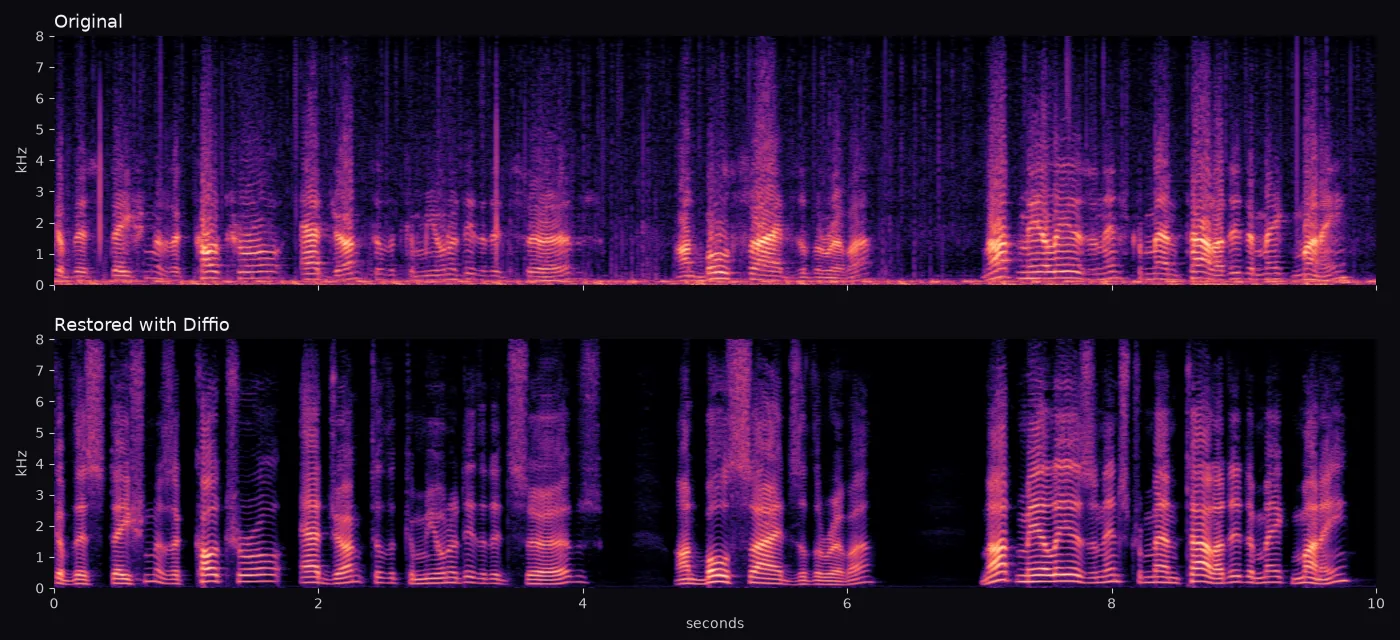
How to read the spectrogram
Ten seconds of the closing passage, around "not merely as an instrumentality to make money", original above and restored below. Time runs left to right, pitch rises from bottom to top, and brighter means louder. In the original, hiss fills the space between his words; after restoration that space goes dark. The restored voice is also brighter than the original, so listen to both.
WKIP and the Roosevelt recordings
The FDR Library's guide to its audio collections lists donations from radio station WKIP among its sources, and notes that its recordings include presidential speeches made in the Hyde Park and Poughkeepsie area and recorded by WKIP.
For journalists, educators and museums
Link this page and credit the Franklin D. Roosevelt Library for the recording.
Credit line and questions
| Reuse | Details |
|---|---|
| Source | FDR Library, recorded utterances of FDR, August 19, 1940 |
| Credit line | "Recording: Franklin D. Roosevelt Library; restored with Diffio AI (diffio.ai)" |
| Questions | Write to me at nathan@trydiffio.com |
The same kind of restoration works on recordings closer to home: an aircheck from a hometown station, a reel of a local broadcast, an oral history taped in a noisy hall. You can hear the result on three free uploads at diffio.ai.
Nathan Harmon is the founder of Diffio AI, based in Colorado Springs.