The test
Tested on the same 59 recordings
All 59 recordings
Averages over 59 clips; thin lines are 95% intervals.
Show the numbers, including estimated speaker similarity
| Tool | Quality gain (SCOREQ) | Word error rate | Estimated speaker similarity |
|---|---|---|---|
| Diffio 4.7 Flash | +2.3495% interval 2.17 to 2.51 | 3.9%95% interval 3.0% to 5.0% | 0.6595% interval 0.61 to 0.68 |
| Diffio 4.7 Pro | +2.3295% interval 2.15 to 2.49 | 4.1%95% interval 3.1% to 5.3% | 0.6595% interval 0.62 to 0.69 |
| Auphonic | +0.8295% interval 0.65 to 1.00 | 13.3%95% interval 10.0% to 16.8% | 0.8495% interval 0.81 to 0.86 |
| Adobe Podcast | +1.8795% interval 1.74 to 2.00 | 18.2%95% interval 13.6% to 23.3% | 0.6295% interval 0.59 to 0.64 |
| Original recording | No processing (average SCOREQ 2.31) | 13.2%95% interval 9.6% to 17.3% | 0.9295% interval 0.92 to 0.93 |
Averages over 59 clips of real recordings, run November 3, 2026 (other tools October 22). A higher SCOREQ gain and a lower word error rate are better. Estimated speaker similarity is an estimate, from the noisy original and the restored file alone, of how closely the restored voice matches the speaker (1 means identical). It replaces the ECAPA similarity to the noisy original, which read too low on damaged input. An untouched original scores about 0.92, so it measures how close the voice stays, not how much was cleaned. How it is estimated. Diffio's results are Diffio 4.7, rendered for this test on November 3, 2026 from its released model on Diffio's own GPUs with the same processing as the app (customer restorations run on Diffio's Mac mini fleet); the other tools ran on October 22, 2026.
Diffio is not affiliated with or endorsed by Adobe or Auphonic. Product names are trademarks of their owners.
What the test found, and how each tool ran
The same 59 real recordings through every tool, each in its strongest speech cleanup mode at default amounts.
Diffio ran Auphonic, Adobe Podcast and its own two models on the same 59 real recordings (test run November 3, 2026; other tools October 22), each in its strongest speech cleanup mode at default amounts. Diffio 4.7 raised the SCOREQ speech quality score by 2.34 (Flash) and 2.32 (Pro) on average, against 0.82 for Auphonic and 1.87 for Adobe Podcast. Clip by clip on SCOREQ, Auphonic scored higher than Diffio 4.7 Pro on 2 of 59 clips and Adobe Podcast on 6.
Where Diffio did not win: On echoey rooms (5 clips), Auphonic (4.2%) had a lower word error rate than Diffio 4.7 Pro (5.8%). On phone and remote calls (3 clips), Auphonic (4.2%) had a lower word error rate than Diffio 4.7 Pro (5.0%). On narration over music (1 clip), Adobe Podcast (+1.74) had a higher quality gain than Diffio 4.7 Pro (+1.69). On narration over music (1 clip), Auphonic (3.7%) had a lower word error rate than Diffio 4.7 Pro (6.3%).
Scores are model predictions, not a human listening test, and Diffio ran the test. The full method and every clip are on the results page.
Averages over all 59 clips. A higher quality gain (SCOREQ) and a lower word error rate are better; the untouched recordings had a 13.2% word error rate.
- Diffio 4.7 Flash (1st of 4 on quality gain): Released Diffio 4.7 weights, Flash sampler, run on Diffio's own GPUs with production's leveling, transcript and output steps; restored speech only. MP3 192 kb/s.
- Diffio 4.7 Pro (2nd of 4 on quality gain): Released Diffio 4.7 weights, Pro sampler, run on Diffio's own GPUs with production's leveling, transcript and output steps; restored speech only. MP3 192 kb/s.
- Adobe Podcast Enhance Speech v2 (3rd of 4 on quality gain): Web app (Premium), Enhance Speech v2, speech stem at 100% enhancement.
- Auphonic (Speech Isolation) (4th of 4 on quality gain): API, Speech Isolation denoiser at default amounts; leveler, loudness, filtering and cutting off. Returns WAV.
What Auphonic does well
Broadcast and platform loudness
Auphonic supports loudness specifications alongside leveling, filtering and enhancement.
Single, multitrack and high-volume production
Its current plans support single productions, multitrack work, batch processing, watch folders and a command-line interface where available.
Publishing workflows
Metadata, chapters, external-service connections, automatic publishing and API access are part of the broader system.
Video support
Auphonic accepts video and supports video outputs and audiograms; video is not a Diffio-only distinction.
Auphonic is a mature production tool for creators who need mastering, loudness delivery, metadata, publishing and automation around their recordings.
Where Auphonic falls short for a focused restoration job
Recurring credits reset
Free and recurring credits do not roll over, while separately purchased one-time credits never expire.
Free exports include a jingle
Auphonic adds its jingle to productions made with the free monthly allowance.
Short jobs have a billing floor
Auphonic documents a three-minute minimum charge per production.
The workflow is broader than restoration
Teams that only need focused restoration of compromised speech may not need mastering, publishing, metadata, or production automation around the job.
Why users switch to Diffio for speech restoration
Damaged speech
Your source speech is compromised by supported noise, reverb or echo, or clipping or distortion.
A focused restore workflow
You want a focused upload-and-restore experience instead of a full podcast production system.
A restoration API
You need a developer API for speech restoration.
Speech in video files
You want to restore the speech soundtrack of a supported video file without editing the picture.
Looking for pay-as-you-go instead of a subscription?
API: $5 an hour, no monthly fee
Diffio's web plans are monthly subscriptions (Basic $8 for 6 hours). The Diffio API is billed per second of audio, $0.001389/second for Diffio 4.7 Flash and $0.002778/second for Diffio 4.7 Pro, with a $5 starting credit and a 60-second minimum per request. There is no monthly fee on the API. See API pricing.
Can you use Diffio and Auphonic together?
Yes: Diffio first, then Auphonic
Yes. Diffio does not level, normalize loudness or master. If you need loudness targets, run Diffio first to restore the speech, then Auphonic. Comparing Adobe Podcast and Auphonic directly? See Adobe Podcast vs Auphonic, or Descript vs Auphonic for cost and clarity.
Compared
Diffio vs Auphonic by workflow
| Need | Diffio | Auphonic |
|---|---|---|
| Primary job | Restore damaged speech | Automated post-production |
| Restoration scope | Noise, echo, clipping | Noise and reverb, in mastering |
| Production workflow | Web app and API | Batch, multitrack, CLI, API |
| Loudness and publishing | – Not included | ✓ Loudness and publishing |
Show all 8 rows
| Need | Diffio | Auphonic |
|---|---|---|
| Primary job | Restore compromised speech | Automate podcast and media post-production |
| Restoration scope | Supported noise, reverb or echo and clipping or distortion cases | Noise and reverb reduction within a broader mastering chain |
| Production workflow | Simple consumer web workflow and developer API | Web productions, multitrack, batch, watch folders, CLI, API and publishing integrations |
| Loudness and publishing | Not a full loudness-compliance or publishing pipeline | Loudness targets, metadata and publishing automation |
| Episode editing and notes | A transcript with every result; no episode editing or show notes | Filler and silence cutting, multilingual speech recognition, plus automatic show notes and chapters |
| Video | Diffio restores the speech soundtrack of supported video files on every plan; Diffio does not edit picture | Broad video input and output workflows |
| Credit model | Web-plan monthly minute allowances | Recurring and free credits reset and do not roll over; separately purchased one-time credits never expire |
| Our 59-clip test (test run November 3, 2026; other tools October 22) | Diffio 4.7 Flash: SCOREQ +2.34 on average, word error rate 3.9%; Diffio 4.7 Pro: SCOREQ +2.32 on average, word error rate 4.1%. Diffio ran the test; scores are model predictions, not a human listening study. Method and every clip. | Auphonic: SCOREQ +0.82 on average, word error rate 13.3%, on the same recordings. |
Other Auphonic alternatives
Diffio ran these on the same recordings as Auphonic in its AI speech enhancer test; each suits a different job.
Adobe Podcast Enhance Speech+1.87 SCOREQ
Adobe Podcast Enhance Speech for a free quick pass on short audio files. See Adobe Podcast alternatives.
Cleanvoice+1.89 SCOREQ
Cleanvoice if you also want filler words and long pauses cut. See Cleanvoice alternatives.
ElevenLabs Voice Isolator+0.79 SCOREQ
ElevenLabs Voice Isolator if you already use ElevenLabs. See ElevenLabs compared.
Descript Studio Sound+0.46 SCOREQ
Descript Studio Sound if you edit by transcript. See Studio Sound compared.
Pricing
Current Auphonic pricing
Prices in US dollars before tax: Auphonic Free includes two processed hours per month with a jingle.
Read the full answer
Monthly recurring credits start at $13 for 9 hours and $30 for 21 hours; annual billing lists those tiers at $11 and $25 per month. One-time credits start at $12 for 5 hours and $23 for 10 hours, and never expire. Check Auphonic's current pricing before purchasing. To compare cost per hour with other tools, see AI audio enhancer pricing.
Each tool's cheapest published plan that covers 5 hours a month, billed month to month; Diffio Basic is $8 a month for 6 hours. Cost per hour at 1, 5 and 20 hours for six tools
All 4 plans and prices
| Plan | Billing | Price (USD) | Hours included | Per hour, fully used |
|---|---|---|---|---|
| Recurring S | Monthly subscription | $13 a month $11 a month billed yearly | 9 hours | $1.44 |
| Recurring M | Monthly subscription | $30 a month $25 a month billed yearly | 21 hours | $1.43 |
| Recurring L | Monthly subscription | $64 a month $52 a month billed yearly | 45 hours | $1.42 |
| Recurring XL | Monthly subscription | $136 a month $113 a month billed yearly | 100 hours | $1.36 |
Show all 5 one-time credit packs
| Plan | Billing | Price (USD) | Hours included | Per hour, fully used |
|---|---|---|---|---|
| One-time 5 hours | One-time pack | $12 | 5 hours | $2.40 |
| One-time 10 hours | One-time pack | $23 | 10 hours | $2.30 |
| One-time 25 hours | One-time pack | $55 | 25 hours | $2.20 |
| One-time 50 hours | One-time pack | $100 | 50 hours | $2 |
| One-time 100 hours | One-time pack | $171 | 100 hours | $1.71 |
Diffio plans: Free: 3 uploads · Basic $8 a month · API $5 an hour
Diffio plans: Free is 3 uploads in total with a 2-minute preview of each result. Basic ($8 a month) includes 6 hours a month and Pro ($29 a month) 30 hours, with full playback and downloads, for audio or video files up to 2 GB and 90 minutes. The API is billed per second at $5 an hour (Diffio 4.7 Flash) or $10 (Diffio 4.7 Pro), with a $5 starting credit. Diffio pricing · API pricing
How it works
How Diffio restores a recording
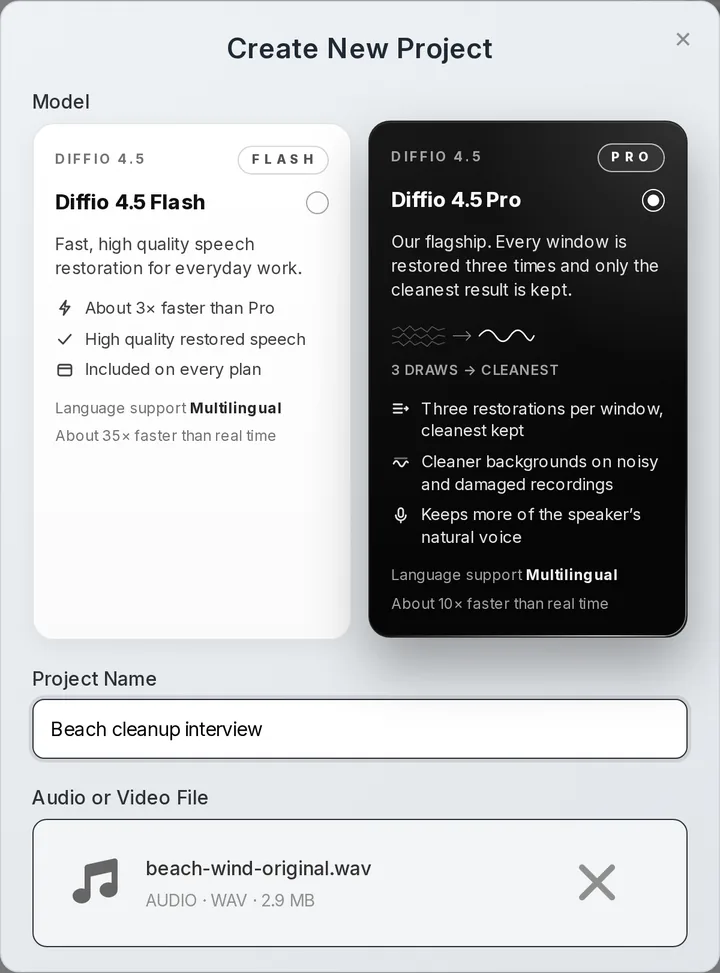
Upload what you recorded
Audio or video, up to 2 GB and 90 minutes per file.
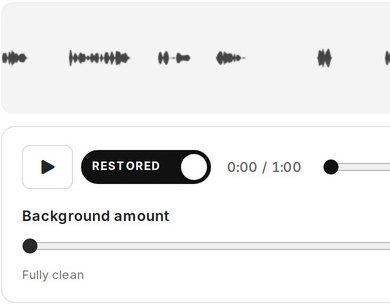
Compare on one playhead
Switch between the original and the restored speech while it plays.
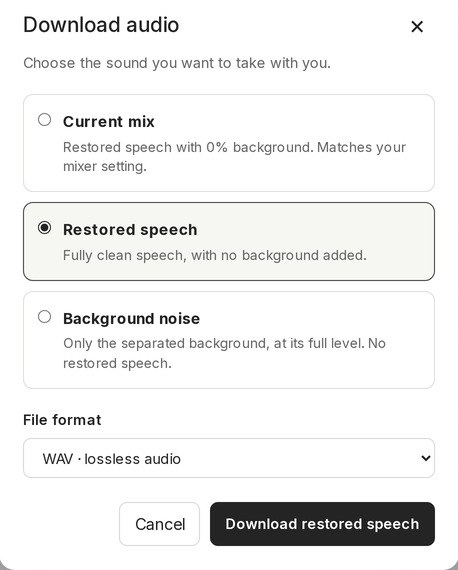
Download what you need
Paid plans download the speech, the background as its own track, or the full video.
- Diffio 4.7 FlashEvery plan, including Free
- Diffio 4.7 ProPaid plans, more model work per step
Questions
Auphonic alternative questions
Does Auphonic remove echo?
Auphonic reduces noise and reverb as one step of its mastering chain. Diffio restores noise, room echo or reverb and some clipping or distortion in recorded speech in one pass; to use both, see Can you use Diffio and Auphonic together? above.
How much does Auphonic cost?
Auphonic has a free monthly allowance, then recurring monthly credits or one-time credits that never expire, in US dollars before tax. Each tier and price is under Current Auphonic pricing.
Does Auphonic support video?
Yes. Auphonic accepts video and supports video outputs and audiograms. Diffio also restores the speech soundtrack of supported video files on every plan.
When is Diffio the better Auphonic alternative?
When the recording itself is damaged by noise, room echo or distortion and you want a focused upload-and-restore workflow or a restoration API rather than a full podcast production system.
Sources
Vendor pages and when we checked them
Vendor prices checked November 10, 2026 on Auphonic's pricing page. Workflow and feature descriptions come from Auphonic's own documentation (last reviewed August 25, 2026). See Auphonic's pricing, credits and feature comparison, use cases, single-production documentation, batch documentation, and command-line interface.